
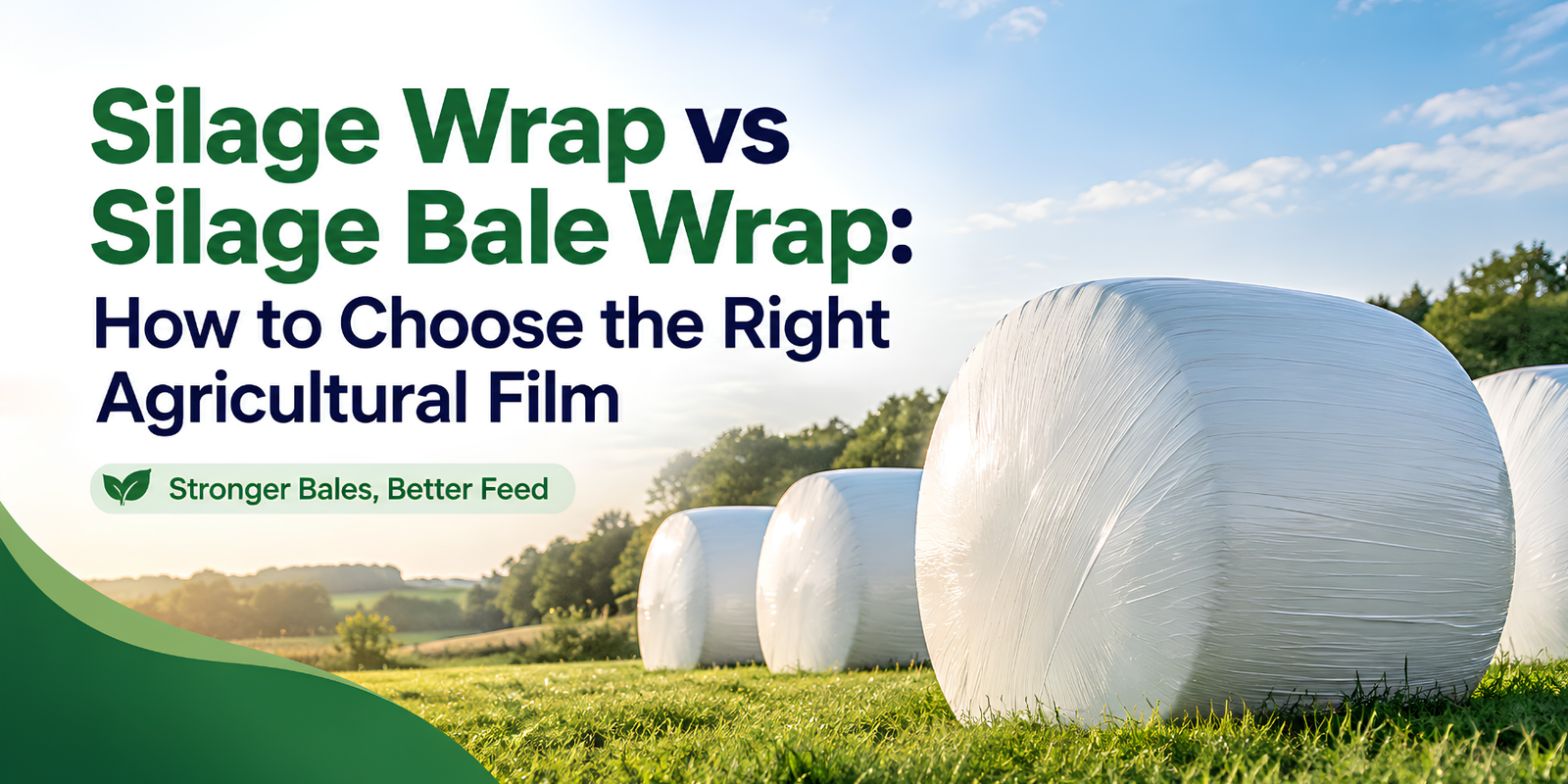
Choosing the right agricultural film is an important decision for farms, agricultural contractors, feed producers, and distributors involved in silage production. The film used to wrap forage directly affects how effectively the bale is protected from oxygen, moisture, contamination, and external damage during storage. When comparing silage wrap and silage bale wrap, the terminology can sometimes be confusing because both solutions are designed to protect baled forage and support the production of high-quality silage. The more important question is whether the selected film provides the right combination of stretchability, puncture resistance, sealing performance, oxygen protection, and durability for the intended application.
For professional agricultural operations, film selection should not be based only on price or thickness. The wrapping process, type of forage, bale dimensions, storage duration, handling conditions, and local weather can all influence the performance required from the film. A reliable agricultural film must stretch consistently around the bale, maintain sufficient tension after wrapping, and create a stable protective layer that helps limit oxygen exposure throughout the storage period.
What Is Silage Wrap?
Silage wrap is a stretchable agricultural film specifically designed for wrapping bales of forage and other plant material for anaerobic storage. During the wrapping process, the film is stretched around the bale in multiple overlapping layers. This creates a protective barrier around the forage and helps limit the entry of air and moisture.
The film needs to combine high elasticity with mechanical strength. Stretchability allows the material to conform closely to the shape of the bale, while puncture and tear resistance help the wrapped bale withstand handling, transportation, and storage. If the film loses tension or becomes damaged during these stages, air can enter the package and potentially compromise the quality of the stored forage.
For professional users, consistent film performance is therefore essential. A film that stretches evenly and maintains reliable overlap can make the wrapping process more predictable while helping create a secure protective package around every bale.
What Is Silage Bale Wrap?
Silage bale wrap refers to agricultural stretch film used specifically to form a protective outer layer around individually baled forage. It is commonly applied using specialized bale-wrapping equipment, which rotates the bale while stretching and wrapping the film around its surface.
The objective is to create multiple overlapping layers that provide effective protection against oxygen and external environmental conditions. Because the film is applied under tension, its mechanical and stretching characteristics are particularly important. The material must be able to stretch without excessive tearing while maintaining enough recovery to keep the wrapped structure tight after application.
Silage bale wrap is therefore not simply a conventional plastic film adapted for agricultural use. It is engineered for a demanding combination of machine processing, high stretching, repeated film overlap, and outdoor storage.
Silage Wrap vs Silage Bale Wrap: Is There a Difference?
In many commercial applications, the terms silage wrap and silage bale wrap describe essentially the same category of agricultural stretch film. The distinction is generally more about how the product is described than about two completely separate types of material.
Silage wrap is the broader term, while silage bale wrap emphasizes the specific application of wrapping individual forage bales. When purchasing film, agricultural buyers should therefore focus less on the terminology and more on the technical properties of the film and whether those properties match the wrapping equipment and storage requirements.
The most important consideration is whether the film can maintain the required stretch, overlap, strength, and protective barrier throughout the entire storage period. A high-quality film should remain securely attached to the bale and resist damage caused by handling, transportation, weather exposure, and contact with other objects.
Why Film Quality Matters for Silage Storage
The fundamental purpose of bale wrapping is to create conditions suitable for the preservation of forage. Once the bale has been wrapped, limiting oxygen exposure becomes critical. The film must therefore create a reliable barrier and remain intact throughout storage.
Film damage can occur at several stages. A bale may be punctured during wrapping, handling, transportation, stacking, or storage. Sharp objects, rough surfaces, bale handling equipment, animals, and environmental conditions can all create risks. Even a relatively small opening in the film can compromise the protective environment around the bale.
This is why mechanical strength is one of the most important characteristics of agricultural silage film. High puncture resistance and good tear resistance help the film withstand the stresses associated with commercial bale handling. Consistent film quality also helps reduce the likelihood of weak points developing during the wrapping process.
Stretchability and Film Performance
Stretchability is another critical factor when selecting silage film. During bale wrapping, the film is intentionally stretched before being applied around the bale. This stretching allows the material to form tightly around irregular surfaces while creating overlapping layers.
The film must be capable of stretching consistently without breaking or becoming excessively thin in localized areas. If the material does not perform consistently during application, the finished bale may have areas with insufficient coverage or inadequate tension.
For agricultural contractors and farms wrapping large numbers of bales, consistent stretch performance can also influence material consumption. A film that provides predictable stretch and reliable coverage can help operators achieve the desired number of layers while using the material efficiently.
Oxygen Protection and Bale Preservation
One of the primary reasons for using silage film is to reduce exposure of the forage to oxygen after wrapping. The wrapped bale needs to maintain a controlled environment during storage, making the film’s barrier performance an important part of the overall preservation process.
The film should maintain its protective characteristics after stretching and throughout the expected storage period. Outdoor storage can expose wrapped bales to changing temperatures, sunlight, wind, rain, and other environmental conditions. The agricultural film therefore needs to remain functional rather than becoming excessively brittle or losing its integrity over time.
Film selection should consequently consider both initial wrapping performance and long-term storage performance. A material that performs well during application but deteriorates rapidly during storage may not provide the required protection for the complete lifecycle of the bale.
Puncture and Tear Resistance
Bales are not always perfectly smooth or uniform. Depending on the forage and baling process, the bale surface can contain areas that place additional mechanical stress on the film. The wrapping process itself can also create tension and friction.
High puncture and tear resistance helps the film withstand these stresses. This becomes particularly important when wrapped bales are moved multiple times or transported over long distances. A film with inadequate mechanical performance can be more vulnerable to damage, increasing the need for inspection and repair.
For professional agricultural operations, selecting a film with a suitable balance of stretchability and mechanical strength is therefore more valuable than simply choosing the thickest available film.
How Bale Size and Shape Affect Film Selection
The dimensions and shape of the bale can influence film consumption and wrapping performance. Larger bales require more film coverage, while irregular bale shapes can place additional stress on the material during application.
The wrapping equipment must also be correctly adjusted for the selected film. Film width, stretch characteristics, wrapping speed, and the number of layers all influence the final result. A film that works effectively on one machine configuration may require different settings on another.
For this reason, agricultural buyers should evaluate the film together with their equipment rather than treating the material as an isolated component. Compatibility between the film and wrapping machine can help improve consistency and reduce unnecessary film breakage.
Choosing Silage Film for Outdoor Storage
Many wrapped bales are stored outdoors, where they are exposed to sunlight and changing weather conditions. This makes resistance to environmental exposure an important consideration when selecting agricultural film.
The film should retain sufficient flexibility and mechanical integrity throughout the intended storage period. Outdoor storage can involve substantial temperature variations, rain, wind, and prolonged exposure to sunlight. A suitable agricultural film must therefore be designed for the conditions in which the wrapped bales will actually be stored.
Storage practices also matter. Even a high-quality film can be damaged if bales are placed against sharp surfaces or handled improperly. Selecting the right film should therefore be combined with appropriate bale handling and storage procedures.
Silage Wrap for Professional Agricultural Operations
For large farms, agricultural contractors, and feed producers, the choice of silage film can affect both operational efficiency and the consistency of the finished bales. Commercial wrapping operations may involve hundreds or thousands of bales, making film reliability particularly important.
A film that stretches consistently, runs smoothly through wrapping equipment, and maintains strong mechanical performance can help reduce interruptions during the wrapping process. Consistent roll dimensions and film properties can also make machine setup more predictable.
For businesses purchasing agricultural film in larger quantities, supplier reliability becomes another important consideration. Consistent specifications from batch to batch can help operators maintain stable wrapping conditions and avoid unexpected changes in material behavior.
How to Choose the Right Silage Bale Wrap
The best silage bale wrap should be selected according to the complete application rather than one specification alone. Agricultural buyers should consider the type and size of bales, wrapping equipment, expected storage period, handling requirements, climate, and desired level of protection.
Film stretch performance is particularly important because the material must form multiple overlapping layers around the bale without breaking. Mechanical strength is equally important for protecting the bale during handling and storage. Barrier performance, outdoor durability, roll consistency, and compatibility with the wrapping machine should also be evaluated as part of the purchasing decision.
Cost per roll should not be the only measurement. A lower-priced film may not necessarily provide the lowest overall packaging cost if it requires additional layers, experiences frequent breaks, or results in damaged bales. Professional users should instead consider the total material consumption, wrapping efficiency, reliability, and protection achieved by the film.
Working With the Right Agricultural Film Supplier
Selecting an experienced agricultural film supplier can make the purchasing process easier, particularly for businesses with specific bale-wrapping requirements. A supplier should be able to discuss the intended application and provide film specifications that correspond to the customer’s equipment and operating conditions.
For international buyers, manufacturing consistency and supply reliability are also important. Agricultural operations often work according to seasonal schedules, so delays or inconsistent material availability can create significant operational problems. A dependable supply of consistent agricultural film can help businesses maintain their wrapping operations during critical periods.
Technical specifications should be evaluated alongside actual application requirements. Film width, thickness, stretch characteristics, mechanical strength, roll configuration, and packaging options can all influence whether a particular product is suitable for a specific wrapping operation.
Why the Right Film Makes a Difference
The purpose of silage wrapping is not simply to cover a bale with plastic. The film becomes an important part of the preservation system, and its performance must remain reliable from the moment the bale is wrapped through the complete storage period.
A suitable film can provide the stretch, coverage, strength, and environmental resistance required to create a secure package around the bale. When the film is matched correctly to the bale, wrapping equipment, handling process, and storage conditions, agricultural businesses can improve consistency and reduce avoidable packaging problems.
For farms and agricultural businesses, the most effective approach is therefore to evaluate the entire application before selecting the film. Understanding how the material will be stretched, how the bales will be handled, how long they will be stored, and what environmental conditions they will experience provides a stronger basis for choosing the right agricultural film.
Conclusion
Silage wrap and silage bale wrap are closely related terms for agricultural stretch film used to protect wrapped forage bales. The most important difference is not the name used to describe the product but whether the film provides the technical performance required by the specific wrapping application.
Stretchability, puncture resistance, tear resistance, barrier performance, outdoor durability, and compatibility with wrapping equipment all play an important role in the selection process. Agricultural buyers should also consider bale dimensions, storage duration, transportation requirements, climate, and overall film consumption before making a purchasing decision.
For professional farms, agricultural contractors, feed producers, and distributors, choosing a reliable agricultural film can support more consistent wrapping operations and help protect bales throughout storage and handling. The right film should provide a practical balance between performance, material efficiency, durability, and supply reliability.