
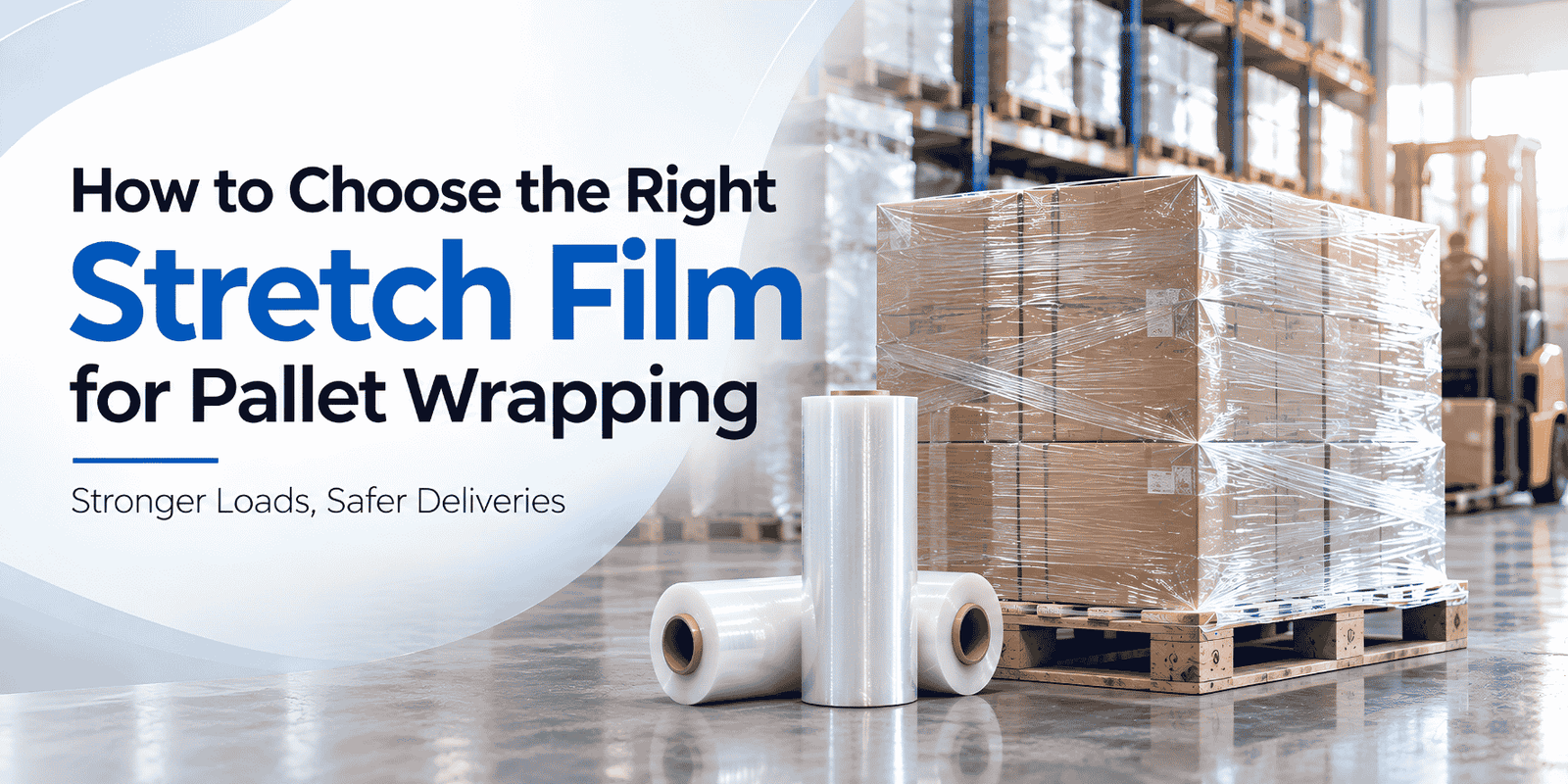
Choosing the right stretch film for pallet wrapping is not simply a matter of selecting the thickest film or the lowest-priced roll. The film has to work with the weight, shape and stability of the load, the way it is applied, and the conditions the pallet will experience during storage and transportation.
A pallet that looks securely wrapped in the warehouse can still become unstable during forklift handling, truck transportation or repeated loading and unloading if the film does not provide enough containment force. On the other hand, using a film that is unnecessarily thick can increase material consumption and packaging costs without providing a meaningful improvement in performance.
The right approach is to match the stretch film to the application. This means considering the pallet load, film thickness, stretch capability, puncture resistance, cling, wrapping method and transportation conditions together.

Why Choosing the Right Stretch Film Matters
Stretch film is designed to hold products together as a stable unit during storage and transportation. When the film is stretched around a pallet, its elastic recovery creates tension around the load. This tension helps reduce movement between cartons, boxes, bags or other products placed on the pallet.
The effectiveness of the wrapping depends on how well the film matches the load. A light, uniform pallet made from strong cartons may require a different film specification from a heavy pallet containing sharp-edged components. Similarly, a regular rectangular load is generally easier to wrap than an irregular load with exposed corners and gaps.
This is why choosing stretch film based only on roll price can be misleading. A cheaper film may require more layers, break more frequently or provide inadequate load containment. A higher-performance film, when correctly matched to the application, may reduce film consumption and improve pallet stability.
Tilak PolyPack offers stretch film in different grades, thicknesses, widths and configurations for manual and machine wrapping applications, allowing the film specification to be matched to different packaging requirements.
Start With the Pallet Load
The first question when selecting stretch film should be: What exactly are you wrapping?
The weight of the pallet is important, but it is not the only consideration. You also need to look at the dimensions, shape, surface characteristics and distribution of the products.
A pallet containing lightweight, evenly stacked cartons may not require the same film performance as a pallet containing heavy machinery components. If the products have sharp corners or edges, puncture resistance becomes more important because the film may be exposed to concentrated stress during wrapping and transportation.
Irregular loads also deserve special attention. Products that extend beyond the pallet footprint, have uneven heights or contain gaps can be more difficult to stabilize. In these situations, choosing a film with appropriate strength and stretch characteristics can help create better load containment.
The goal is not to find the strongest film available. The goal is to find a film that can reliably contain the specific load without unnecessary material use.
Consider the Weight and Dimensions of the Pallet
A heavy pallet generally places greater demands on the film because the contents have more momentum when the pallet is moved or transported.
However, pallet weight should always be considered together with pallet dimensions. A relatively light but very tall pallet can still be difficult to stabilize because the centre of gravity is higher. A wide pallet may also require a wrapping pattern and film width that provides adequate coverage across the load.
For heavy or oversized pallets, the film needs enough strength and puncture resistance to withstand the forces created during wrapping and handling. Tilak PolyPack also offers stretch-film solutions for applications where load size and strength requirements differ from standard pallet loads.
Film Thickness Is Important, But Thicker Does Not Always Mean Better
Film thickness is one of the most commonly considered specifications when buying stretch film. It is generally expressed in microns or gauge.
A thicker film can provide greater material strength and may be appropriate for demanding loads, but selecting thickness by itself is not enough. Film performance also depends on the formulation, stretch capability, puncture resistance and how the film is applied.
For example, a thinner high-performance film may provide better material efficiency than a thicker lower-performance film when both are properly matched to the application.
Tilak PolyPack currently lists standard stretch-film thicknesses including 12, 15, 18, 23 and 29 microns, with other thicknesses available on request.
This gives buyers flexibility, but the correct thickness should be determined according to the actual load rather than choosing a specification simply because it is thicker.
How Do You Know Which Thickness You Need?
Start by looking at the typical loads your business wraps rather than choosing a thickness for an individual pallet.
If your operation handles several different pallet types, identify the lightest, average and heaviest loads and evaluate how the film performs on each. Look for film breakage, excessive stretching, poor load containment or unnecessary film usage.
The objective is to establish a specification that consistently protects the majority of your loads while avoiding over-packaging.

Choose Between Manual and Machine Stretch Film
The application method is another major factor.
Manual stretch film is designed to be applied by an operator, making it suitable for warehouses and businesses where pallet volumes are smaller or where loads vary significantly. It does not require a wrapping machine and can be used directly at the warehouse or loading area.
Machine stretch film is intended for automated or semi-automated wrapping equipment. It becomes particularly valuable when a business wraps large numbers of pallets and wants more consistent wrapping tension, speed and film usage.
The important question is therefore not simply whether machine film is “better.” It is whether the wrapping process would benefit from automation.
For high-volume operations, machine wrapping can provide greater consistency and efficiency. For smaller operations or businesses handling highly varied loads, manual stretch film can offer greater flexibility.
Tilak PolyPack supplies both manual and machine stretch-film grades.
When Should You Consider Pre-Stretch Film?
Pre-stretch film is produced with the film already stretched before it is applied to the pallet. This can help reduce the effort required during wrapping and can improve material efficiency.
For businesses focused on controlling film consumption, pre-stretch can be particularly interesting because more pallet coverage can be achieved from a smaller amount of film when the application is properly controlled.
However, pre-stretch film should still be evaluated according to the load. The fact that a film is pre-stretched does not automatically make it suitable for every pallet configuration.
Tilak PolyPack offers pre-stretch film in both hand and machine formats, with standard options as well as custom widths.
Cast or Blown Stretch Film?
Another important decision is whether cast or blown stretch film is more appropriate for the application.
Cast stretch film is commonly valued for its clarity and smooth, consistent unwinding. It can be useful when product visibility and efficient application are important.
Blown stretch film is generally associated with higher puncture resistance and strength, making it useful for loads with irregular shapes, sharp edges or more demanding handling conditions.
Neither option is universally better. The right choice depends on what your pallet looks like and what it experiences during transportation.
If the load is relatively uniform and visibility and smooth application are priorities, cast film may be appropriate. If puncture resistance is a major concern because of irregular or sharp-edged products, blown film may deserve consideration.
Think About Puncture Resistance
Puncture resistance becomes especially important when pallets contain sharp corners, rough surfaces or products that can place concentrated pressure on the film.
If the film repeatedly tears during application, increasing the number of layers may appear to solve the problem, but it can also increase film consumption and labour.
A better approach is to determine why the film is failing.
Is the pallet overloaded? Are cartons protruding beyond the pallet? Are sharp edges contacting the film? Is excessive tension being applied? Or is the film specification simply unsuitable for the load?
Addressing the underlying cause can produce a better result than simply adding more layers.
Consider Cling and Load Containment
Stretch film needs to remain securely wrapped around the pallet throughout storage and transportation. Cling characteristics help layers of film hold together and contribute to the overall integrity of the wrapped load.
However, good wrapping performance is the result of several factors working together. Film cling, stretch, tension, wrapping pattern and the characteristics of the load all influence final containment.
A film that has good cling but is poorly applied may still produce an unstable pallet. Similarly, a high-strength film cannot compensate for a badly stacked load.
This is why film selection and wrapping technique should always be considered together.
Consider the Transportation Environment
The pallet’s journey matters.
A pallet moving a short distance inside a warehouse experiences very different conditions from one transported across multiple cities or countries.
Long-distance transportation can expose pallets to vibration, braking, acceleration, repeated handling and changes in storage conditions. Export shipments may also spend significant periods in warehouses, containers or loading areas before reaching their final destination.
If pallets are exposed to sunlight or outdoor conditions, UV resistance may become relevant. For metal products where corrosion protection is important, VCI stretch film may be worth considering. Tilak PolyPack specifically offers VCI stretch film designed to help protect metal objects from rust.
For businesses with sustainability targets, recycled or biodegradable stretch-film options can also be evaluated where they are compatible with the application. Tilak PolyPack’s range includes recycled stretch wrap and biodegradable stretch wrap.
Don’t Ignore the Wrapping Machine or Applicator
A stretch film specification also needs to be compatible with the equipment used to apply it.
For manual wrapping, the operator needs a roll that can be handled comfortably while maintaining consistent tension. For machine wrapping, the film must work with the machine’s settings, stretch system, roll dimensions and operating speed.
A film that performs well on one wrapping machine may not produce identical results on another machine if the stretch settings or application conditions are different.
Before changing film specifications, businesses should therefore evaluate the interaction between the film and the equipment rather than testing the film in isolation.
Look at Film Consumption, Not Just Price Per Roll
One of the most common purchasing mistakes is comparing stretch films only by price per roll.
Suppose Film A costs less per roll but breaks more frequently and requires more layers. Film B may cost more per roll but cover more pallets and provide better containment with less material.
The more useful metric is the cost of wrapping a pallet, not simply the price of the roll.
Businesses should consider the amount of film used per pallet, number of wraps, film failures, operator time, pallet stability and product damage when comparing suppliers.
This approach can reveal that a higher-performance film provides a lower overall packaging cost even when its individual roll price is higher.
How Many Layers of Stretch Film Should You Use?
There is no universal number of layers that is correct for every pallet.
The required amount depends on the film, load weight, pallet configuration, wrapping method and required containment. A stable uniform pallet may need a different wrapping pattern from a tall or irregular load.
Instead of automatically adding more layers, monitor the finished pallet. If the products shift during normal handling, the film specification or wrapping pattern may need to be adjusted.
Likewise, if large amounts of film are being used without a measurable improvement in stability, the packaging process may be over-specified.
The best wrapping process is the one that achieves reliable containment with controlled material consumption.
Common Mistakes When Choosing Pallet Stretch Film
One of the most common mistakes is choosing film solely according to price. Another is assuming that thicker film will always produce better results.
Businesses also sometimes use the same film specification for every pallet even when the loads vary significantly. This can lead to either under-protection of demanding loads or unnecessary material consumption on lighter loads.
Another mistake is ignoring the wrapping equipment. Manual and machine applications can require different film characteristics, and machine settings can significantly influence how much stretch film is actually consumed.
Finally, businesses sometimes focus on the film but overlook pallet stacking. Even the right stretch film cannot completely compensate for an unstable pallet configuration.
A Practical Way to Select Stretch Film
A simple selection process can make purchasing decisions much easier.
Start by documenting the typical pallet loads your business handles. Record their approximate weight, dimensions, product shape and whether they have sharp edges or irregular surfaces.
Next, identify how the pallets are wrapped. If wrapping is performed manually, evaluate hand stretch film. If the business operates a high-volume automated wrapping line, machine stretch film may be more appropriate.
Then evaluate film thickness, stretch capability, puncture resistance and cling according to the load.
Finally, test the film under real operating conditions. Measure how much film is used per pallet and monitor load stability throughout normal handling and transportation.
This produces a much more useful result than choosing a film based on a specification sheet alone.

Which Stretch Film Is Right for Your Business?
The right stretch film depends on your specific packaging operation.
For light and standard loads, a general-purpose stretch film may provide the required protection. Heavy or irregular loads may require greater puncture resistance and containment. High-volume operations may benefit from machine stretch film, while smaller warehouses may prefer manual stretch film.
Pre-stretch film can be useful when reducing material consumption and operator effort is a priority. Specialized films such as VCI, recycled, biodegradable or anti-static stretch film may be appropriate when the application has additional requirements.
The important point is to select the film according to the load, application and operating conditions, rather than selecting the thickest or cheapest film available.
Why Work With a Stretch Film Manufacturer?
Working directly with a stretch film manufacturer can be useful when your business requires consistent specifications, custom dimensions or different film grades for different applications.
Tilak PolyPack supplies stretch film in manual and machine grades and offers different widths, thicknesses, colours and specialized options. Its product range includes standard stretch film as well as pre-stretch, coreless, VCI, recycled and biodegradable solutions.
For businesses wrapping multiple types of pallets, discussing the application with the manufacturer can help determine whether one film specification is suitable for all loads or whether different grades would provide better performance and cost control.
Final Thoughts
Choosing the right stretch film roll for pallet packaging is ultimately about finding the right balance between load stability, film performance, material consumption and operating efficiency.
Start with the load rather than the roll. Consider its weight, dimensions, shape, edges and transportation conditions. Then match those requirements with the appropriate film thickness, stretch characteristics, puncture resistance and application method.
Manual, machine, pre-stretch, cast, blown and specialized stretch films each have their place. The best option is the one that consistently secures your pallets without unnecessary film consumption.
For businesses that handle a variety of pallet loads, testing the film under real operating conditions is one of the most reliable ways to determine the right specification.
If you are unsure which stretch film specification is suitable for your pallet loads, share your typical pallet weight, dimensions, product type and wrapping method with a stretch-film manufacturer. The right recommendation should be based on the actual application rather than a generic film specification.