
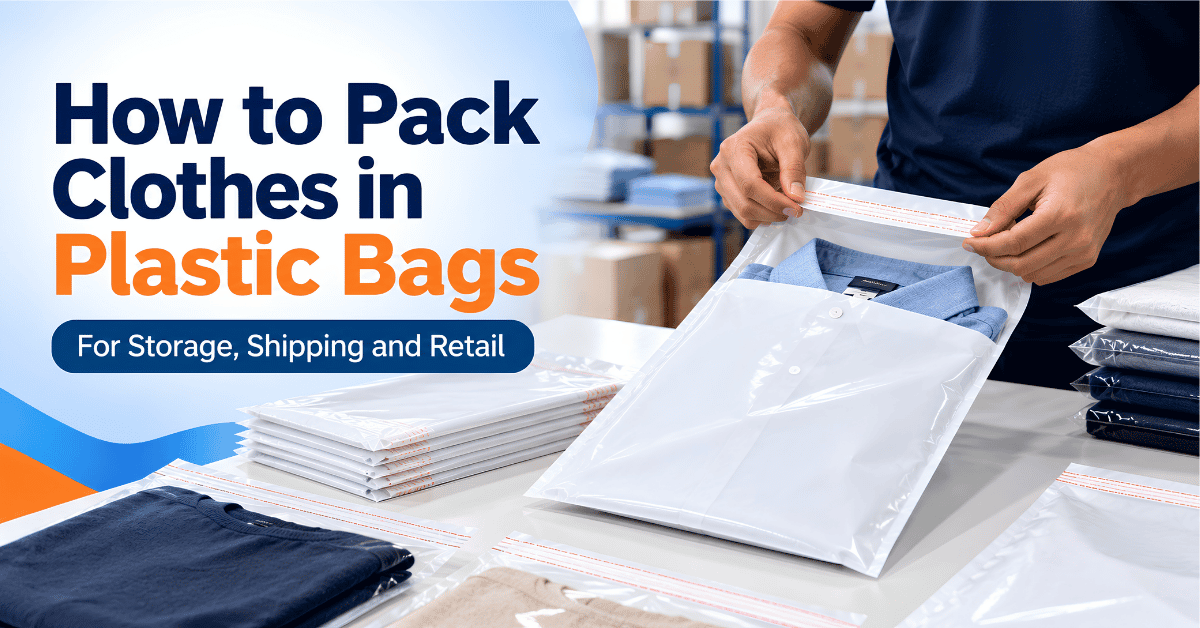
Packing clothes properly is important when garments need to be stored, transported, displayed, or shipped to customers. A suitable plastic bag can help keep individual garments organized and reduce exposure to dust, dirt, and general handling during distribution. For garment manufacturers, retailers, wholesalers, exporters, and e-commerce businesses, the right combination of bag size, thickness, and closure can also make the packing process faster and more consistent. This guide explains how to pack clothes in plastic bags, how to select suitable packaging, and what to consider when preparing garments for storage, shipping, and retail fulfillment.
Why Are Plastic Bags Used for Packing Clothes?
Plastic bags are commonly used to package individual garments because they provide a simple outer layer around the clothing while keeping each item separated and easier to handle. In garment production and retail operations, individually packed clothes can be stacked, sorted, stored, and dispatched more conveniently than loose garments.
For businesses handling large quantities of apparel, clothing packing bags can also help create a consistent packing process. A shirt, T-shirt, pair of jeans, uniform, or dress can be folded and placed inside an appropriately sized bag before it moves to storage, shipment, retail display, or customer delivery.
Plastic garment packaging can be useful for:
- Protecting packed garments from dust and dirt during routine handling
- Keeping individual clothing items organized in storage
- Preparing garments for retail presentation
- Packaging apparel for wholesale distribution
- Preparing e-commerce orders for dispatch
- Separating garments during transportation and shipment
The type of bag should be selected according to the garment dimensions, folding method, thickness requirement, and closure system.
How to Prepare Clothes Before Putting Them in a Plastic Bag
Good packaging starts before the garment enters the bag. Clothes should be prepared so they fit comfortably inside the selected packaging without excessive compression or forcing the garment into a bag that is too small.
Before packing, check the following:
- Make sure the garment is clean and dry.
Garments should be fully dry before being placed inside packaging. Moisture trapped inside closed packaging can create an unsuitable storage environment for the garment. - Fold the garment consistently.
A consistent folding method helps maintain a uniform package size and makes it easier to select the appropriate bag. - Check the folded dimensions.
Measure or estimate the length and width of the folded garment before selecting the bag size. - Avoid excessive overfilling.
The garment should sit naturally inside the bag without putting unnecessary stress on the seams or closure area. - Check the opening and sealing area.
When using a peel-and-seal bag, leave enough space at the top for the adhesive flap to close correctly.
This preparation becomes especially important when a business is packing hundreds or thousands of garments and needs a repeatable packaging process.
How to Pack Clothes in Plastic Bags
The actual process of packing clothes in plastic bags is straightforward, but consistency is important when packaging garments for commercial use.
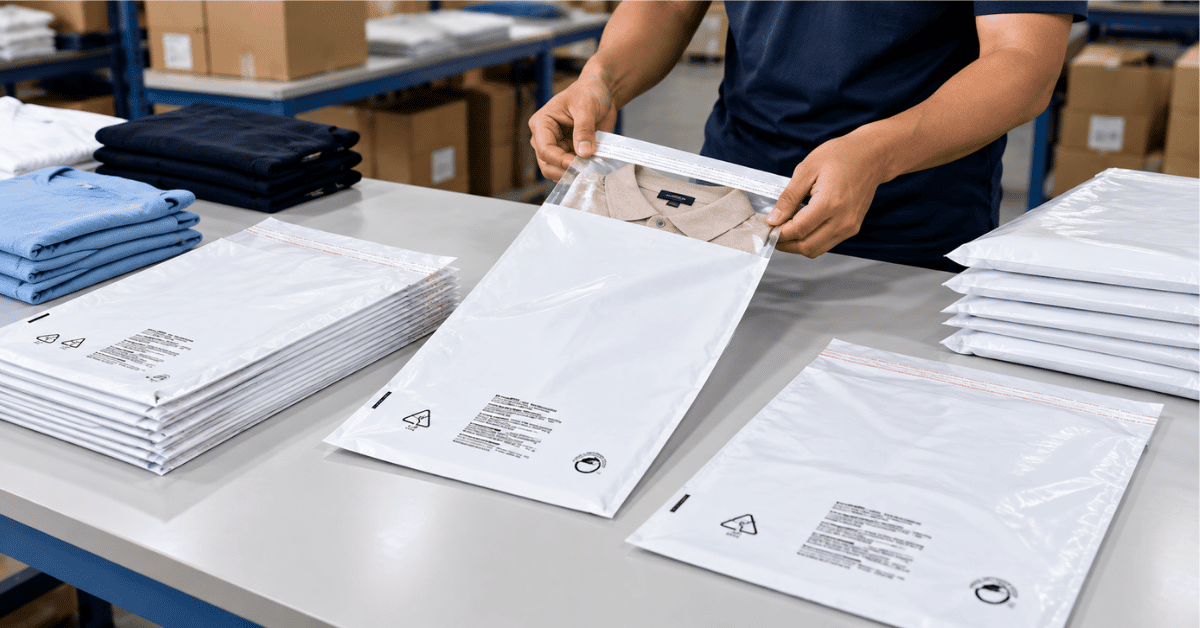
Start by placing the folded garment on a clean packing surface. Select a bag that is large enough to accommodate the garment without excessive empty space. Carefully insert the folded clothing into the bag, making sure that corners, sleeves, or other parts of the garment are not unnecessarily caught in the opening.
Once the garment is properly positioned, check the bag for obvious folds or obstructions around the closure area. For a self-sealing or peel-and-seal bag, remove the protective release liner from the adhesive strip and fold the flap over the opening. Press along the sealing area to close the bag securely.
For larger-scale garment operations, businesses may establish standard packing procedures based on garment category and size. For example, shirts and T-shirts may use one bag specification, while folded jeans, dresses, or heavier garments may require different dimensions or thickness.
A consistent process helps reduce packing errors and makes finished packages easier to sort, store, and dispatch.
Peel-and-Seal Bags for Garment Packaging
A peel-and-seal bag uses an adhesive strip on a flap that folds over the opening of the bag. This closure method is useful when garments need to be packed and sealed individually without additional heat-sealing equipment.
The main practical advantages of a peel-and-seal closure include:
- Quick closing after the garment is inserted
- Simple packing procedure
- A neat finished package
- Convenient individual garment handling
- Suitable for retail and e-commerce order preparation
For businesses looking for polythene clothing packing bags, peel-and-seal construction can be a useful option where individual garments need to be packed efficiently.
You can see the available product here: Polythene Clothing Packing Bags.
The appropriate bag size and thickness should still be selected according to the garment and handling conditions rather than choosing one specification for every product.
Choosing the Right Plastic Bag Size for Clothes
Bag size has a direct effect on how easily a garment can be packed and how the final package looks. A bag that is too small can make insertion difficult, while an unnecessarily large bag can leave excessive empty space around the folded garment.
When selecting a size, consider:
| Consideration | Why it matters |
|---|---|
| Garment length | Helps determine the required bag length |
| Folded width | Helps determine the required bag width |
| Garment thickness | Important when packing thicker apparel |
| Folding method | Different folds produce different package dimensions |
| Closure area | Adequate space is needed for the flap to seal |
| Storage method | Final package dimensions matter when products are stacked |
For businesses packing multiple categories of clothing, it may be more practical to use different bag sizes rather than trying to fit every garment into one standard dimension.
Choosing the Right Thickness
The required film thickness depends on the type of garment, the way it will be handled, and the conditions it may encounter during storage or transportation. Lightweight clothing may have different packaging requirements from heavier garments or products that experience more frequent handling.
When specifying thickness, consider the complete packaging process rather than focusing only on the thickness number. The bag should be appropriate for the garment dimensions, closure requirements, packing method, and expected handling.
For bulk garment packaging, businesses can discuss the required dimensions and thickness based on the products being packed.
Plastic Bags for Clothes in Retail and E-Commerce
Retail and e-commerce businesses often need individual garment packaging that is easy to identify, organize, store, and dispatch. A packaged garment can be handled without directly exposing the clothing during routine movement between storage and fulfillment areas.
For e-commerce orders in particular, packaging can form part of the fulfillment workflow. Garments may be folded, individually packed, checked, labeled, grouped with other products, and then prepared for shipment.
Clear or translucent packaging can also allow the contents to be identified without opening every individual package, which can be useful when garments are sorted by size, style, color, or product type.
Using Clothing Packing Bags for Shipping and Storage
Garment packaging does not stop at the packing table. After a clothing item has been packed, the package may pass through storage areas, transportation networks, warehouses, retailers, or fulfillment centers before reaching the final customer.
Individual clothing bags can help keep garments separated during these stages. They can also make stock handling more organized because each garment remains inside its own package rather than being exposed as loose inventory.
For long-distance transportation, businesses should consider the entire packaging system, including outer cartons, secondary packaging, and handling conditions. The individual plastic bag is one part of the overall garment packaging process.
Common Mistakes When Packing Clothes in Plastic Bags
Even simple garment packaging can become inefficient when the wrong bag or packing method is used. Some common issues can be avoided through standardized procedures.
Using a bag that is too small
A garment should fit comfortably inside the packaging. Forcing clothing into an undersized bag can make packing slower and may interfere with proper closure.
Packing damp garments
Clothing should be appropriately dry before being placed into closed packaging, particularly when the package is intended for storage.
Choosing one bag size for every garment
Shirts, jeans, dresses, uniforms, and other apparel can have different folded dimensions. Multiple bag sizes may be more suitable for a mixed garment range.
Overfilling the package
The bag should be appropriate for the quantity and type of clothing being packed. Excessive filling can make sealing and handling more difficult.
Closing the adhesive flap incorrectly
For peel-and-seal bags, the closure area should be clean and aligned properly before the flap is pressed closed.
Ignoring the final use of the package
Packaging intended for short-term retail handling may have different requirements from packaging used throughout manufacturing, warehousing, shipping, and e-commerce fulfillment.
Can Clothing Packing Bags Be Customized?
Yes. Clothing packing bags can be supplied according to the requirements of the garment and the packaging operation. Businesses may require different bag dimensions or thicknesses depending on their product range and packing process.
Customization may include:
- Bag width and length
- Film thickness
- Peel-and-seal closure
- Printing requirements
- Branding
- Product identification
- Packaging specifications for different garment categories
For large garment operations, defining packaging specifications in advance can make the packing process more consistent across different production batches.
What Types of Clothes Can Be Packed in Plastic Bags?
Plastic clothing packing bags can be used for many common apparel products, including:
- Shirts
- T-shirts
- Jeans
- Trousers
- Dresses
- Sarees
- Uniforms
- Children’s garments
- Fashion apparel
- Workwear
- Other folded textile products
The appropriate bag specification depends on the dimensions and characteristics of the garment being packed.
Frequently Asked Questions
Can clothes be packed in plastic bags?
Yes. Plastic bags can be used for individually packing garments for storage, transportation, retail handling, and e-commerce fulfillment. The appropriate material, dimensions, thickness, and closure should be selected according to the application.
What type of plastic bags are used for clothes packaging?
Polyethylene bags are commonly used for clothing packaging. They can be supplied in different sizes and thicknesses, and peel-and-seal versions can be used when an adhesive closure is required.
Are peel-and-seal bags suitable for garment packaging?
Yes. Peel-and-seal bags provide an adhesive flap that allows an individual garment to be inserted and the bag to be closed without additional sealing equipment.
What size plastic bag is suitable for packing clothes?
The suitable size depends on the dimensions of the folded garment. Businesses should consider the garment’s length, width, thickness, folding method, and required closure area when selecting a bag.
Can clothing packing bags be customized?
Yes. Clothing packing bags can be supplied in different dimensions and thicknesses, with customization options discussed according to garment type and packaging requirements.
Conclusion
Packing clothes in plastic bags can help businesses organize garments for storage, shipping, retail handling, and e-commerce fulfillment. The most suitable approach depends on the garment dimensions, folding method, bag size, film thickness, and closure system. For individual garment packaging, peel-and-seal bags provide a convenient way to insert and securely close each item while maintaining an organized packing process.