
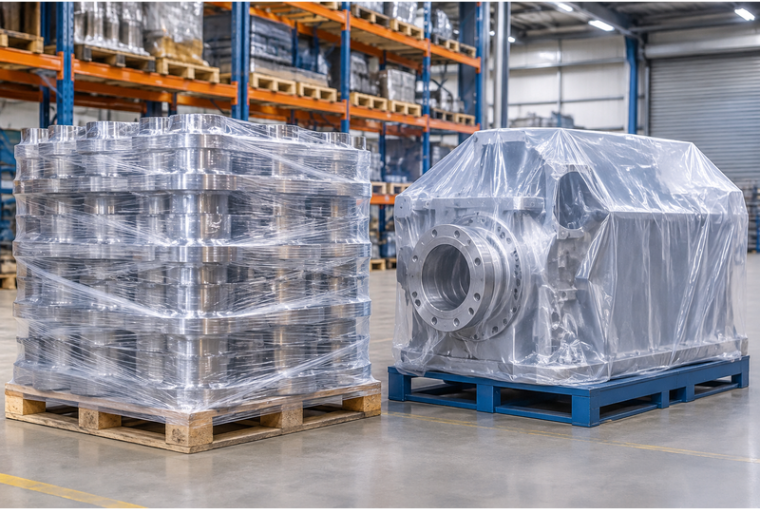
Metal components can develop corrosion during storage, handling and transportation when packaging is not suitable for the surrounding conditions. For manufacturers, engineering companies, metal processors and industrial exporters, selecting the right protective packaging is therefore an important part of shipment planning.
VCI stretch wrap and VCI shrink film are two packaging formats used for metal protection. Both use vapor corrosion inhibitor technology, but their application methods and enclosure characteristics differ. The right selection depends on the shape of the load, packaging equipment, storage environment and protection requirements. Understanding these differences helps procurement and packaging teams choose a suitable solution without relying on one packaging format for every shipment.
Understanding the Difference Between VCI Stretch Wrap and VCI Shrink Film
VCI stretch wrap is applied by stretching the film around a product or pallet load. The film is held in place through tension and is commonly used to bundle metal parts or secure palletized shipments. It can be applied manually or through compatible wrapping equipment, making it relevant to manufacturing facilities and distribution operations that already use stretch-wrapping processes.
VCI shrink film follows a different application method. The film is positioned around the equipment or product and heat is applied according to the product’s instructions. The material contracts to form a closer-fitting enclosure. This makes shrink packaging useful for certain large, irregularly shaped or equipment-based loads where a fitted protective covering is required. The exact enclosure performance depends on the film, seams and packaging design.
Key Differences Industrial Buyers Should Evaluate
The main difference is not simply which film provides more protection. Buyers should evaluate how the packaging format works with their load and shipping process.
| Selection factor | VCI stretch wrap | VCI shrink film |
|---|---|---|
| Application | Applied under stretching tension | Applied using a heat-shrinking process |
| Packaging equipment | Manual or compatible stretch wrapper | Heat gun or suitable shrink system, depending on product |
| Typical packaging format | Palletized loads and bundled metal parts | Fitted coverings for equipment and larger items |
| Enclosure | Tension-wrapped enclosure | Closer-fitting enclosure when correctly applied |
| Process consideration | Integration with existing stretch-wrapping operations | Heat application, worker safety and controlled sealing |
| Selection priority | Load containment and wrapping efficiency | Enclosure design and environmental protection requirements |
These are general format differences, not universal performance guarantees. A manufacturer’s VCI formulation, film construction, packaging design and application instructions must be considered before deciding which product is appropriate.
1. Consider the Shape and Size of the Metal Load
The physical characteristics of the material being packaged should be one of the first considerations. Regular palletized products, metal components grouped into bundles and similar loads may be suitable for tension-applied wrapping. The film can be applied around the load while helping to maintain its packaging configuration during handling.
Large machinery, irregular structures and equipment with different dimensions may require a different enclosure approach. A shrink-film system can be considered when the packaging plan requires a closer-fitting covering around the equipment. Before selecting either format, packaging teams should review sharp edges, protruding parts, surface geometry and the possibility of film punctures.
For steel coils, bearings, fabricated parts and machinery assemblies, the packaging method should be selected according to the actual load design rather than the product category alone.
2. Evaluate Storage and Transportation Conditions
A shipment travelling between two nearby manufacturing facilities may have different protection requirements from equipment being stored for an extended period before international dispatch. Buyers should assess the complete logistics route, including warehouse conditions, container handling, transit duration and possible exposure to humidity or changing temperatures.
A properly designed shrink enclosure may be appropriate where the application requires a closer-fitting protective covering. Stretch wrapping may be appropriate for palletized loads and operations that prioritize efficient wrapping and load containment. Neither format should automatically be considered sufficient for every outdoor, marine or high-humidity application.
ZERUST’s published comparison also distinguishes between tension-applied stretch wrapping and heat-applied shrink packaging, while emphasizing that the environmental conditions and enclosure design affect selection. This should be treated as application guidance rather than a universal rule for all VCI products.
3. Match the Film to the Existing Packaging Process
Manufacturing plants often have established packaging workflows. Some operations wrap products manually, while higher-volume facilities use automatic or semi-automatic wrapping systems. Introducing a different packaging method can affect production layout, operator training, handling procedures and dispatch processes.
VCI stretch wrap can be considered where the facility already uses compatible manual or machine stretch-wrapping equipment. Buyers should confirm the required roll dimensions, film handling characteristics and equipment compatibility before introducing a new film specification.
Shrink wrapping requires an appropriate heat-application process. The operation must account for the equipment, operator training, product geometry and safe working conditions. The packaging team should also confirm that the selected shrink film is suitable for the metal product and its intended environment.
4. Check Metal Compatibility and VCI Formulation
Not every corrosion-inhibiting packaging formulation should be assumed to work identically with every metal. A buyer may be packaging ferrous metals, non-ferrous metals or assemblies containing more than one metal type. The VCI formulation should therefore be checked against the actual material combination.
Procurement teams should request product-specific technical information and confirm which metals are covered by the supplier’s documentation. They should also check whether the film is intended for direct contact, enclosure packaging or another application method. Where assemblies contain different materials, compatibility should be established before full-scale implementation.
A suitable packaging trial is useful when the shipment involves valuable components, unfamiliar materials or changing storage conditions. This helps the packaging team evaluate the complete packaging design rather than relying only on the film name.
5. Prepare the Metal Parts Before Wrapping
Packaging quality depends on more than the film itself. Metal parts should be prepared in accordance with the approved packaging procedure. Existing moisture, contamination, handling residues and surface conditions should be considered before the product is enclosed.
Industry supplier guidance commonly emphasizes handling clean parts carefully, avoiding unnecessary contact with metal surfaces and checking product compatibility before use. Daubert Cromwell, for example, recommends glove use, prompt packaging of clean products, appropriate storage of unused VCI materials and compatibility testing. The precise procedure should always follow the instructions for the selected VCI product.
Packaging teams should also inspect the wrapped load for tears, open areas, damaged edges and incomplete coverage. A properly selected film cannot compensate for a poorly executed wrapping process.
6. Build a Selection Process Around the Shipment
Before approving a packaging format, procurement and engineering teams should document the shipment requirements. Start by identifying the metal types, load dimensions, weight, surface geometry and packaging configuration. Next, define the expected storage period and the environmental conditions likely to affect the shipment.
The team should then evaluate the existing wrapping equipment, operator capabilities and any heat-application requirements. Supplier technical documentation should be reviewed for the recommended VCI formulation, application instructions and compatibility. Finally, carry out a packaging trial under representative conditions and record the results before adopting the format for regular shipments.
For operations considering VCI stretch wrapping, reviewing the specifications and application details of VCI stretch film can help establish whether the available product configuration matches the packaging requirements. Facilities using automated operations can also review machine stretch film options when assessing equipment compatibility.
Conclusion
Choosing between VCI stretch wrap and VCI shrink film requires an understanding of the metal load, packaging process and transportation environment. Stretch wrapping may suit palletized loads and existing wrapping operations, while shrink wrapping may be appropriate where a closer-fitting enclosure is required. The final decision should be based on the actual metal compatibility, product documentation, enclosure design and packaging trial.
Industrial buyers should avoid selecting a film solely because it is described as a corrosion-protection product. A well-planned packaging system combines the right VCI formulation with suitable handling, application and storage practices. Reviewing the shipment requirements with the packaging supplier helps businesses establish a more reliable approach to protecting metal products during storage and transportation.