
Introduction
In many warehouses and manufacturing units, packaging decisions are often influenced by operational speed, shipment volume, labor availability, and packaging cost. While automated wrapping systems are common in large distribution centers, many businesses still rely on manual stretch film because of its flexibility and low operational investment.
Manual stretch film is widely used for securing pallets, bundling cartons, and stabilizing loads during storage and transportation. For businesses handling moderate packaging volumes or irregular shipments, it offers a practical and cost-effective solution without requiring expensive wrapping equipment.
From retail distribution centers to small manufacturing facilities, hand wrapping continues to play an important role in everyday packaging operations. However, knowing when manual wrapping is the right choice can help companies improve packaging efficiency while reducing unnecessary material and labor costs.
What Is Manual Stretch Film?
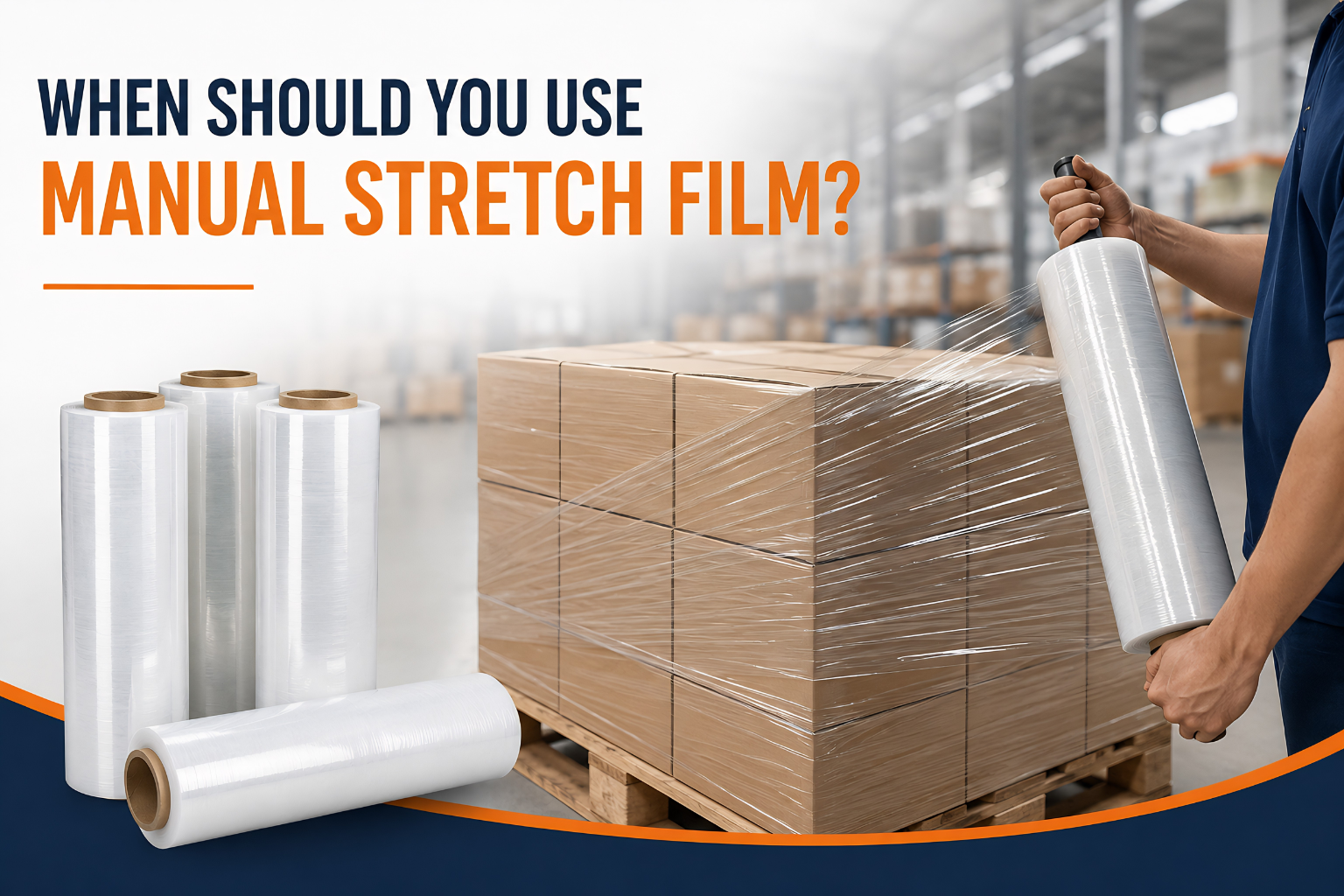
Manual stretch film, also known as hand wrap film, is a stretchable plastic film designed for hand application around products or pallets. The film stretches tightly around the load and uses its cling properties to hold items securely together.
Unlike machine-applied film, manual stretch film does not require automated wrapping systems. Operators can wrap pallets directly using hand rolls, making it suitable for warehouses where packaging volumes are manageable and flexibility is important.
Most manual stretch films are manufactured using linear low-density polyethylene (LLDPE), which provides a balance of stretchability, puncture resistance, and load stability. Depending on packaging requirements, the film is available in different thicknesses, widths, and colors.
How Manual Stretch Film Works in Packaging Operations
The purpose of pallet wrapping is not only to hold products together but also to reduce movement during storage and transportation. During transit, unstable loads can shift, causing damaged cartons, collapsed pallets, or rejected deliveries.
Manual stretch film works by applying controlled tension around the load. As the film stretches, it creates containment force that stabilizes the products on the pallet.
In warehouse environments, operators typically begin wrapping at the pallet base and continue upward in overlapping layers. Proper wrapping technique improves:
- Load stability
- Dust and moisture protection
- Packaging consistency
- Handling safety during forklift movement
The cling properties of the film also eliminate the need for tapes or straps in many applications.
When Manual Stretch Film Is the Right Choice
Small to Medium Packaging Volumes
Manual wrapping is ideal for businesses that do not process a high number of pallets daily. If a warehouse wraps only a limited number of shipments per shift, investing in automatic stretch wrapping machines may not be financially practical.
Small manufacturers, regional distributors, and local warehouses often prefer manual stretch film because it allows packaging flexibility without machinery costs.
For example, a spare parts distributor shipping 20 to 40 pallets daily can efficiently manage packaging operations using hand wrap film rolls while keeping operational expenses under control.
Warehouses Without Automatic Wrapping Machines
Not every facility has space or budget for semi-automatic or fully automatic wrapping systems. In such situations, manual stretch film becomes the most practical option.
Many businesses initially start with manual pallet wrapping before upgrading to machine wrapping as shipment volumes increase.
Manual wrapping is especially useful in:
- Temporary warehouse setups
- Seasonal operations
- Start-up manufacturing facilities
- Remote dispatch locations
- Backup packaging stations
Since no machinery is required, operators can perform wrapping tasks almost anywhere within the warehouse.
Irregular or Mixed Loads
One of the biggest advantages of manual stretch film is flexibility during pallet wrapping. Automated systems work best with uniform pallet sizes, but many businesses handle irregular cartons, mixed SKU pallets, or uneven loads.
Manual wrapping allows operators to apply extra reinforcement where needed. This is useful for:
- Odd-shaped industrial products
- Mixed retail shipments
- Fragile packaging
- Lightweight stacked cartons
- Partial pallets
In these situations, hand-applied wrapping provides better control compared to machine wrapping.
Retail and Distribution Applications
Retail supply chains often require fast and flexible pallet preparation. Distribution centers handling promotional stock, mixed inventory, or frequent order changes commonly use manual stretch film for short-run pallet wrapping.
Retail warehouses also benefit from the transparency of clear stretch film, which allows barcode scanning and quick visual inspection without opening the load.
Temporary or Mobile Packaging Operations
Some industries require packaging at customer sites, temporary projects, or mobile loading areas. Since manual stretch film rolls are portable and easy to carry, they are commonly used outside fixed packaging stations.
For example:
- Construction material suppliers
- Event equipment logistics
- Agricultural product handling
- On-site industrial packaging
In these applications, portability becomes a major operational advantage.
Industries That Commonly Use Hand Wrap Film
Manual stretch film is used across multiple industries because of its versatility and low equipment dependency.
Common sectors include:
- FMCG distribution
- Pharmaceuticals
- Textile manufacturing
- Automotive components
- Electronics packaging
- Food and beverage logistics
- Agriculture and fertilizers
- E-commerce warehousing
Each industry uses pallet wrapping differently, depending on product sensitivity, shipment distance, and storage conditions.
Advantages of Manual Stretch Film
Lower Initial Investment
One of the main reasons businesses choose manual stretch film is affordability. Unlike machine wrapping systems, there is no need for capital investment in equipment.
This makes it suitable for businesses managing packaging budgets carefully.
Flexible Packaging Operations
Manual wrapping gives operators direct control over wrapping tension and layer application. This flexibility is important for warehouses handling variable pallet sizes.
It also allows businesses to quickly adapt to changing packaging requirements without machine adjustments.
Improved Load Protection
A properly wrapped pallet experiences less shifting during transportation. Stretch film also protects products from:
- Dust accumulation
- Minor moisture exposure
- Surface scratches
- Handling damage
Additional film layers can be applied for heavier or unstable loads.
Easy Storage and Handling
Manual stretch film rolls are compact and easy to store. Warehouses can keep multiple roll sizes available without requiring dedicated machinery space.
Limitations You Should Consider
Although manual stretch film offers many advantages, it may not be suitable for every operation.
Labor Dependency
Manual pallet wrapping requires physical effort and operator time. In high-volume warehouses, wrapping large numbers of pallets manually can slow down dispatch operations.
Inconsistent Wrapping Quality
The effectiveness of pallet wrapping often depends on operator technique. Uneven tension or insufficient overlap can reduce load stability.
Training warehouse staff on proper pallet wrapping methods is important for maintaining consistency.
Reduced Efficiency for High Volumes
As shipment volumes increase, machine stretch wrapping usually becomes more economical and efficient.
Facilities wrapping hundreds of pallets daily often transition to automated systems to reduce labor costs and improve wrapping speed.
Manual Stretch Film vs Machine Stretch Film
Choosing between manual and machine stretch film depends largely on packaging scale and operational workflow.
|
Factor |
Manual Stretch Film | Machine Stretch Film |
|
Equipment Requirement |
No machinery needed |
Requires wrapping machine |
|
Best For |
Low to medium volume |
High-volume operations |
|
Flexibility |
High |
Moderate |
|
Wrapping Speed |
Slower |
Faster |
|
Labor Requirement |
Higher |
Lower |
| Initial Investment | Low |
Higher |
For many growing businesses, manual wrapping serves as an efficient starting point before scaling into automation.
How to Choose the Right Manual Stretch Film Rolls
Selecting the correct film specification is important for packaging performance.
Factors to consider include:
Film Thickness
Heavier loads generally require thicker films for better puncture resistance and containment force.
Common thickness options include 12 micron, 15 micron, 18 micron, and higher grades depending on application needs.
Roll Width
Different pallet sizes require different roll widths. Wider rolls improve wrapping speed for larger pallets.
Cling Performance
Good cling properties help the film adhere securely without additional fastening materials.
Environmental Conditions
Some applications may require UV-resistant, antistatic, or VCI-added stretch films for specialized industrial use.
Best Practices for Effective Pallet Wrapping
Even high-quality stretch film performs poorly if wrapping methods are incorrect.
For better load stability:
- Start wrapping from the pallet base
- Maintain consistent film tension
- Overlap each layer properly
- Reinforce pallet corners if needed
- Apply extra layers on unstable loads
Warehouse operators should also inspect pallets before dispatch to ensure wrapping integrity.
Why Packaging Quality Matters During Transit
Transportation environments expose pallets to vibration, movement, humidity, and handling impact. Poorly secured loads can result in damaged goods, customer complaints, and supply chain delays.
Using quality manual stretch film helps maintain pallet integrity throughout logistics operations. For businesses shipping products across long distances, reliable pallet wrapping directly affects delivery performance and product safety.
High-performance packaging materials also reduce the chances of product returns caused by transit damage.
Conclusion
Manual stretch film remains one of the most practical packaging solutions for businesses handling moderate shipment volumes, irregular loads, or flexible warehouse operations.
It provides reliable pallet stability, reduces packaging costs, and allows businesses to secure products without investing in automated equipment. While machine wrapping may eventually become necessary for large-scale operations, manual pallet wrapping continues to offer strong value for many industrial and commercial applications.
Businesses selecting the right hand wrap film should evaluate shipment frequency, pallet type, load weight, and operational workflow before choosing film specifications.
For companies looking for dependable packaging performance, high-quality manual stretch film rolls from Tilak Polypack can help improve load stability, warehouse efficiency, and transit protection.