
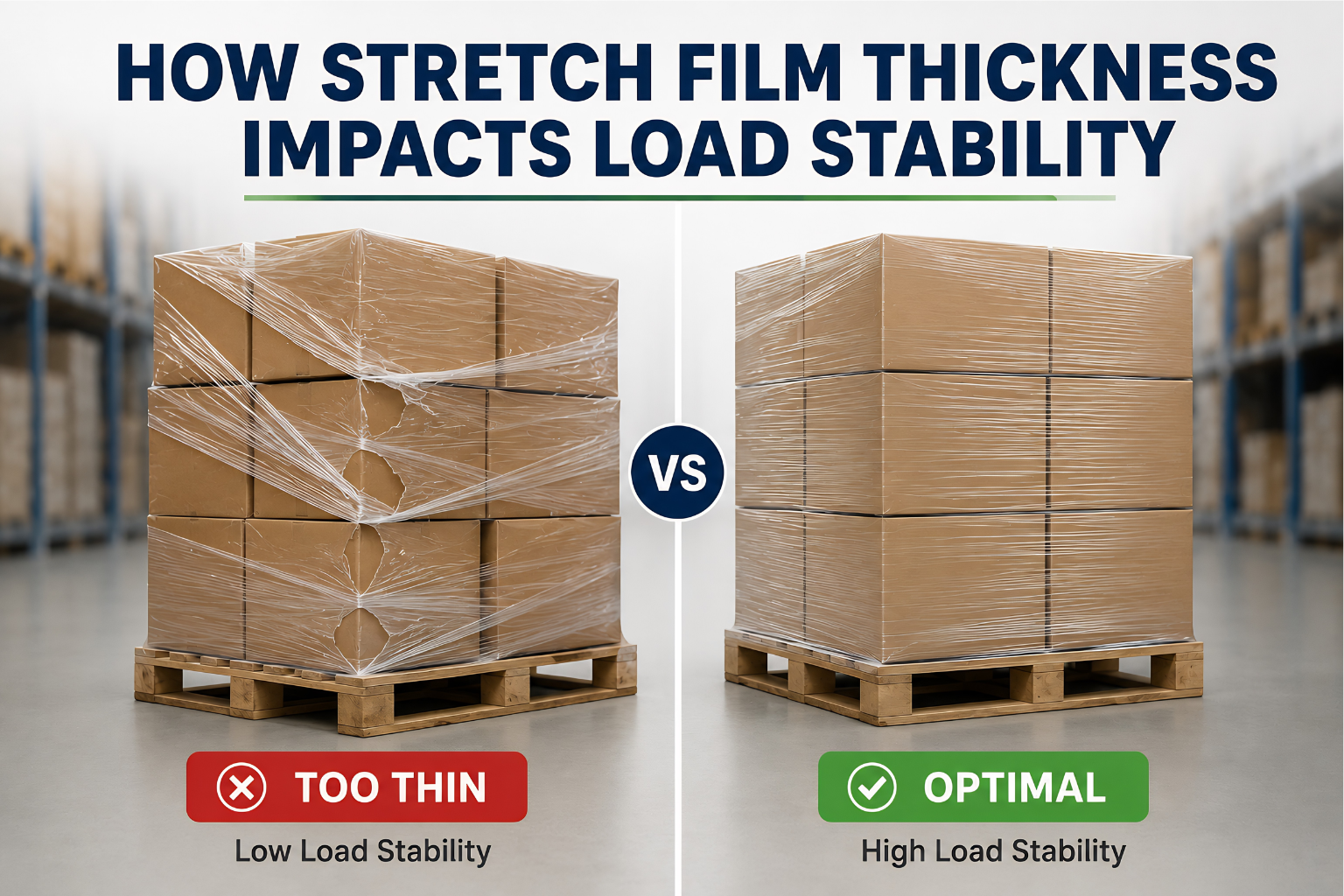
In industrial packaging, even a small mismatch in stretch film thickness can create major problems during transportation and warehouse handling. Unstable pallet loads lead to damaged products, rejected shipments, safety risks, and increased packaging costs. For manufacturers, exporters, and warehouse operators, understanding how stretch film thickness affects load stability is essential for maintaining packaging efficiency and reducing transit damage.
The right stretch film thickness helps maintain proper load containment force, prevents pallet shifting, and improves packaging reliability across supply chains. Whether pallets are transported locally or shipped internationally, selecting the correct film gauge directly impacts wrapping performance and product protection.
Industrial operations often focus heavily on pallet configuration and wrapping equipment while overlooking one critical factor the film itself. However, stretch film thickness plays a central role in determining how effectively a pallet load remains secure during storage, forklift movement, and transportation.
According to the product specifications provided by Tilak Polypack, stretch films are available in multiple thickness ranges including 12, 15, 18, 23, and 29 microns to support different packaging applications and load requirements.
Understanding Stretch Film Thickness
Stretch film thickness refers to the measurement of the film’s gauge or micron level. In industrial packaging, thickness is usually measured in microns or gauge depending on regional standards.
Thicker films generally provide:
- Higher puncture resistance
- Better load holding strength
- Improved tear resistance
- Stronger containment force
Thinner films, on the other hand, are commonly used for lightweight pallet loads where excessive force is unnecessary.
However, choosing the thickest film available is not always the best approach. Excessively thick film may increase packaging costs, reduce stretch efficiency, and create unnecessary material usage. The correct thickness depends on the type of load, transportation conditions, pallet dimensions, and wrapping method.
For example, a warehouse shipping lightweight FMCG cartons may successfully use 12–15 micron film, while heavy industrial machinery components may require 23–29 micron stretch film for proper load stability.
Why Load Stability Matters in Industrial Packaging
Load stability refers to the ability of a palletized load to remain secure and intact throughout storage and transportation.
In industrial logistics, unstable pallets can create several operational challenges:
- Product damage during transport
- Leaning or collapsed pallets
- Worker safety hazards
- Increased product returns
- Delays during warehouse handling
- Higher repackaging costs
Stretch film acts as the primary load containment system for many palletized shipments. When properly selected and applied, it keeps products tightly unitized while absorbing movement and vibration during transit.
Modern warehouses often handle dynamic supply chain conditions including:
- Long-distance transportation
- Export container movement
- Cold storage environments
- High-speed conveyor systems
- Automated warehouse operations
Each of these conditions places additional stress on pallet wrapping performance. Selecting the correct stretch film gauge becomes critical under such circumstances.
How Film Thickness Influences Pallet Performance
Stretch film thickness directly affects how much containment force the film can maintain around a pallet load.
Containment force is the pressure exerted by the stretched film to hold products together. If the film is too thin for the load weight or shape, the pallet may loosen during transit.
Higher Thickness Improves Puncture Resistance
Industrial pallets often contain sharp edges, irregular cartons, metal parts, or protruding corners. Thin films can puncture easily under pressure, especially during forklift handling.
Thicker stretch films provide stronger puncture resistance, making them suitable for:
- Metal fabrication industries
- Chemical packaging
- Automotive components
- Construction materials
- Heavy industrial products
Film Thickness Affects Stretch Memory
A plastic wrap roll made for pallet packaging can provide the stretch and elastic recovery needed to help keep loads tightly wrapped over time.
If the film is too thin, it may lose holding force quickly, especially during long warehouse storage periods or temperature fluctuations.
Load Weight Distribution Matters
Not all pallet loads distribute weight evenly. Uneven loads create stress points where film failure commonly occurs.
For example:
- Tall pallet stacks require stronger vertical containment
- Irregular-shaped loads create tension imbalance
- Heavy bottom-loaded pallets increase sidewall pressure
In such situations, selecting the proper stretch film thickness significantly improves pallet wrapping consistency.
Thin vs Thick Stretch Film: When to Use Each
There is no universal film thickness suitable for every packaging application.
Thin Stretch Film Applications
Lower micron films are commonly used for:
- Lightweight cartons
- Consumer packaged goods
- Stable pallet loads
- Short transportation distances
- Automated high-speed wrapping lines
Benefits include:
- Lower material cost
- Reduced plastic consumption
- Higher yield per roll
- Faster wrapping efficiency
However, thin films may struggle with unstable or heavy loads.
Thick Stretch Film Applications
Higher gauge stretch films are preferred for:
- Heavy industrial loads
- Export shipments
- Long-distance transportation
- Irregular pallet configurations
- Products with sharp corners
These films provide stronger containment and better durability under harsh logistics conditions.
Industrial packaging teams often balance cost savings with load protection. Using overly thin film to reduce material costs can ultimately increase damage claims and operational losses.
The Relationship Between Stretch Film Gauge and Load Containment
Stretch film gauge and load containment are closely connected. As pallet weight increases, the film must generate sufficient force to prevent movement.
Several factors influence containment performance:
Load Height
Tall pallets experience more movement during transport due to shifting center of gravity.
Transportation Vibration
Road vibration gradually loosens poorly wrapped pallets. Thicker films maintain tension more effectively during long-distance shipping.
Temperature Changes
Cold storage and export containers expose pallets to temperature fluctuations. Inferior or under-gauged films may lose elasticity under these conditions.
Wrapping Pattern
Film thickness alone cannot guarantee stability. Proper overlap, wrap count, and tension settings are equally important.
Industrial packaging operations often conduct load testing to determine the optimal combination of:
- Film thickness
- Stretch percentage
- Wrap pattern
- Rotational tension
- Pallet configuration
Industry Applications and Packaging Examples
Different industries require different pallet wrapping strategies based on product characteristics.
Food and Beverage Industry
Beverage pallets are extremely heavy and prone to movement during transportation. These loads often require stronger stretch film gauge for secure pallet containment.
Cold chain logistics may also require vented film options to improve airflow around perishable products. According to Tilak Polypack’s product information, vented stretch films help reduce condensation and maintain freshness for produce and cold-storage goods.
Pharmaceutical Warehousing
Pharmaceutical products require clean, stable packaging with minimal contamination risk. Proper film thickness helps maintain carton integrity during storage and distribution.
Industrial Manufacturing
Manufacturers transporting metal components or machine parts typically use higher thickness films due to sharp edges and concentrated load pressure.
Export Packaging
Export shipments face multiple handling points including:
- Container loading
- Port movement
- Customs inspection
- Long transit durations
Thicker pallet wrapping solutions improve packaging reliability throughout the export chain.
Common Mistakes When Choosing Stretch Film Thickness
Many businesses select stretch film based only on price rather than packaging performance.
This approach often creates long-term operational problems.
Using Thin Film for Heavy Loads
Thin film may initially appear cost-effective but can increase pallet failures during transportation.
Ignoring Load Shape
Irregular pallet configurations require stronger containment force compared to uniform cartons.
Incorrect Machine Settings
Even high-quality stretch film performs poorly when wrapping equipment is improperly calibrated.
Over-Wrapping Pallets
Adding excessive film layers increases packaging costs without necessarily improving stability.
A balanced approach between film thickness, wrapping technique, and load type delivers better overall efficiency.
Machine Wrapping vs Hand Wrapping Considerations
Film thickness selection also depends on the wrapping method.
Machine Wrapping
Machine-applied stretch film typically achieves higher stretch efficiency and more consistent tension control.
Pre-stretched films and optimized gauges are commonly used in automated packaging lines to reduce film consumption while maintaining containment force.
Hand Wrapping
Manual pallet wrapping usually requires slightly thicker film because tension consistency depends on the operator.
Hand-applied packaging operations often prioritize:
- Easier handling
- Better puncture resistance
- Reduced film breakage
Tilak Polypack offers both manual and machine wrapping options for industrial applications.
How to Select the Right Stretch Film Thickness
Selecting the correct stretch film thickness involves evaluating the complete packaging environment rather than focusing on one specification alone.
Key considerations include:
- Pallet weight
- Product shape
- Transportation distance
- Storage conditions
- Wrapping equipment
- Required containment force
- Risk of puncture or tearing
Businesses should also evaluate whether specialized additives such as UV protection, antistatic properties, or VCI technology are required for specific industrial environments.