
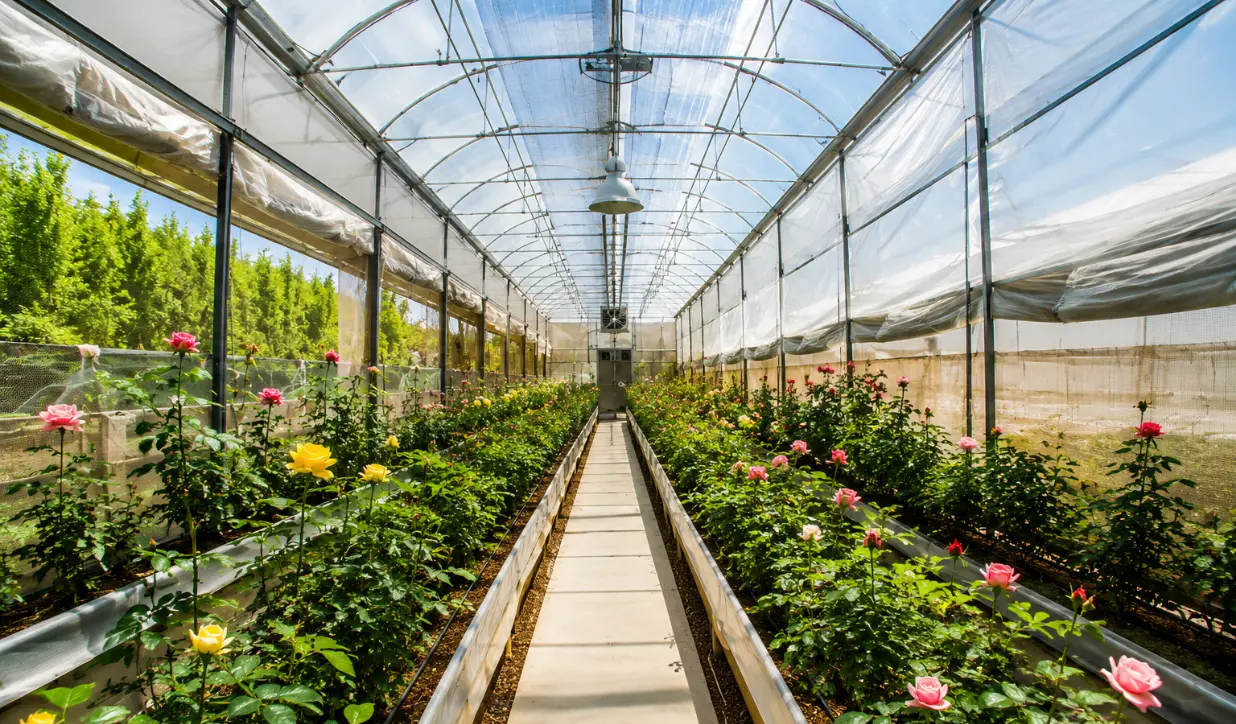
Tilak Polypack manufactures and supplies Greenhouse Film made from polyethylene for protected cultivation, commercial agriculture, nurseries, floriculture, vegetable farming, and other greenhouse applications. Our greenhouse plastic film is designed to provide reliable crop protection while allowing the light transmission required for healthy plant growth.
Available in 180 micron and 200 micron thicknesses and 4 meter and 4.5 meter widths, our greenhouse film can be supplied with performance features such as UV stabilization, anti-fog properties, and light diffusion. These features help greenhouse structures maintain a suitable growing environment under different agricultural conditions.
Greenhouse Film Specifications
| Specification | Details |
|---|---|
| Material | Polyethylene |
| Film Type | Greenhouse Film |
| Thickness | 180 Micron / 200 Micron |
| Width | 4 Meter / 4.5 Meter |
| UV Protection | UV Stabilized |
| Features | Anti-Fog, Light Diffusion, Weather Resistant |
| Applications | Greenhouses, Nurseries, Floriculture, Vegetable Farming |
What Is Greenhouse Film?
Greenhouse Film is a flexible polyethylene covering used to enclose greenhouse and protected cultivation structures. It allows natural sunlight to enter while helping protect crops from rain, wind, dust, and other outdoor conditions. By controlling the growing environment, greenhouse film supports the cultivation of vegetables, fruits, flowers, nursery plants, and other crops.
Polyethylene greenhouse film can be manufactured with different performance characteristics depending on the requirements of the cultivation project. UV stabilization helps the film withstand prolonged sunlight exposure, while anti-fog and light-diffusion properties can improve conditions inside the greenhouse.
The appropriate greenhouse film depends on factors such as the greenhouse structure, crop, climate, required film thickness, light requirements, and expected service conditions.
Greenhouse Plastic Film for Protected Cultivation
Greenhouse plastic film, also known as polyethylene greenhouse film, is widely used as a covering material for commercial greenhouses and polyhouses. Its flexibility makes it suitable for covering different greenhouse structures, while its transparent surface allows natural light to reach the crops.
For agricultural projects, the performance of the film is influenced by its thickness, UV stabilization, optical properties, mechanical strength, and resistance to outdoor weather conditions.
Tilak Polypack supplies greenhouse film for applications where dependable polyethylene covering is required for protected agriculture, horticulture, floriculture, nurseries, and commercial crop production.
Key Features of Our Greenhouse Film
Our greenhouse film is designed to provide a combination of flexibility, strength, light management, and outdoor durability.
UV Stabilized Greenhouse Film
UV stabilization helps protect polyethylene film from degradation caused by prolonged exposure to ultraviolet radiation. This helps maintain the film’s physical properties and performance during outdoor use.
Anti-Fog Greenhouse Film
Anti-fog properties help reduce the formation of large water droplets on the inner surface of the film. Better condensation management can help maintain light transmission and reduce direct water dripping onto plants.
Light Diffused Greenhouse Film
Light-diffusion properties distribute incoming light more evenly within the growing area. This can help reduce concentrated hot spots and provide more uniform illumination across crops.
Weather Resistant Construction
Greenhouse film must withstand changing outdoor conditions. Our polyethylene film is designed for agricultural use where resistance to weather exposure, wind, and normal handling is required.
Flexible and Easy to Install
Polyethylene greenhouse film is lightweight and flexible, making it suitable for installation over different greenhouse and protected cultivation structures.
Benefits of Greenhouse Film
Choosing the appropriate greenhouse film can help growers manage the environment around their crops and protect plants from changing outdoor conditions.
Key benefits include:
- Helps protect crops from rain, wind, dust, and other environmental exposure
- Allows natural light to enter the growing environment
- Supports controlled cultivation under greenhouse structures
- Helps manage condensation when anti-fog film is used
- Supports more uniform light distribution with light-diffused film
- UV stabilization helps protect the film during outdoor exposure
- Suitable for different agricultural and horticultural applications
- Available in different thickness and width options
- Supports commercial and protected cultivation projects
Applications of Greenhouse Film
Greenhouse film is used across a wide range of protected agriculture applications.
Commercial Greenhouses
Used as a covering material for commercial greenhouse structures where crop protection and environmental management are required.
Polyhouses
Polyhouse structures commonly use polyethylene film as a flexible covering to create a more controlled cultivation environment.
Vegetable Farming
Greenhouse film can be used for protected cultivation of vegetables where growers need greater control over growing conditions.
Floriculture
Suitable for greenhouse structures used to cultivate flowers and ornamental plants.
Nurseries and Seedling Production
Greenhouse film helps create a protected environment for nursery plants, seedlings, and young crops.
Fruit and Horticultural Crops
Used in protected cultivation projects for selected fruit and horticultural crops where greenhouse structures are required.
Hydroponic and Protected Agriculture Projects
Greenhouse film can also be used with controlled cultivation systems where crops are grown under protected structures.
Types of Greenhouse Film
Different greenhouse projects can require different film characteristics. Common options include UV stabilized, anti-fog, light-diffused, and multi-layer polyethylene greenhouse films.
UV Stabilized Greenhouse Film
UV stabilized film is formulated to improve resistance to ultraviolet exposure and help maintain the film’s physical properties during outdoor use.
Anti-Fog Greenhouse Film
Anti-fog film is designed to reduce condensation droplets on the inside surface of the greenhouse covering.
Light Diffused Greenhouse Film
Light-diffused film helps distribute sunlight more evenly throughout the greenhouse, supporting more uniform light conditions.
Multi-Layer Greenhouse Film
Multi-layer film construction can combine different material properties within the film to provide a balance of strength, optical performance, UV protection, and durability.
How to Choose the Right Greenhouse Film
Selecting greenhouse film involves more than choosing a thickness. The film should match the greenhouse structure, crop, climate, and required optical and physical properties.
1. Consider Film Thickness
The available 180 micron and 200 micron options provide different thickness choices for greenhouse projects. The appropriate option depends on the structure and operating conditions.
2. Consider UV Stabilization
Greenhouses exposed to strong sunlight require film with suitable UV stabilization to help maintain performance during prolonged outdoor exposure.
3. Consider Light Transmission
Natural light is important for crop growth. Film selection should consider the amount and type of light required by the crops being cultivated.
4. Consider Light Diffusion
Light-diffused film can help distribute sunlight more evenly within the greenhouse and reduce areas of concentrated direct light.
5. Consider Condensation
Where condensation is a concern, anti-fog greenhouse film can help reduce water droplet formation on the inner film surface.
6. Consider Local Climate
The greenhouse film should be selected according to local weather conditions, including sunlight exposure, wind, temperature, humidity, and seasonal conditions.
7. Consider the Crop
Vegetables, flowers, fruits, nursery plants, and other crops can have different light and environmental requirements. Film selection should therefore be aligned with the cultivation system.
Why UV Stabilized Greenhouse Film Matters
Ordinary polyethylene exposed continuously to sunlight can gradually lose its physical properties because of ultraviolet radiation. UV stabilized greenhouse film incorporates stabilizing additives intended to improve resistance to UV exposure.
This is particularly relevant for agricultural structures that remain outdoors for extended periods. Suitable UV stabilization helps the film maintain its flexibility, strength, and optical performance during use.
The actual service life of greenhouse film depends on the film formulation, UV exposure, climate, installation, structure, and maintenance conditions. Therefore, service life should be evaluated according to the specific application rather than assuming a fixed number of years.
Greenhouse Film for Commercial Agricultural Projects
Commercial greenhouse projects require covering material that is compatible with the structure and the intended cultivation conditions. Film selection may involve several factors, including thickness, width, UV stabilization, light transmission, light diffusion, condensation management, and weather exposure.
Tilak Polypack supplies polyethylene greenhouse film in 180 micron and 200 micron thicknesses and 4 meter and 4.5 meter widths for agricultural and protected cultivation requirements.
For larger projects, buyers can discuss their required dimensions, specifications, application, and supply requirements with our team before placing an order.
Why Choose Tilak Polypack for Greenhouse Film?
Tilak Polypack manufactures and supplies polyethylene films for agricultural and industrial applications. Our greenhouse film range is designed around the requirements of protected cultivation projects and can be supplied in different thickness and width options.
We offer:
- Polyethylene greenhouse film
- UV stabilized film options
- Anti-fog film options
- Light-diffused film options
- 180 micron and 200 micron thicknesses
- 4 meter and 4.5 meter widths
- Bulk supply capability
- Custom manufacturing options
- Product specification support
Whether you require greenhouse film for commercial agriculture, polyhouses, horticulture, floriculture, nursery production, or another protected cultivation project, our team can discuss the appropriate product specifications for your application.
Request Greenhouse Film Specifications and Bulk Supply
Looking for Greenhouse Film for a commercial agriculture, polyhouse, nursery, horticulture, or protected cultivation project?
Frequently Asked Questions
What is greenhouse film used for?
Greenhouse film is used as a flexible covering for greenhouse and polyhouse structures. It allows natural light to enter while helping protect crops from outdoor conditions such as rain, wind, and dust.
What is greenhouse plastic film?
Greenhouse plastic film is a polyethylene covering material designed for greenhouse and protected cultivation structures. It is available in different thicknesses and can include properties such as UV stabilization, anti-fog performance, and light diffusion.
What is polyethylene greenhouse film?
Polyethylene greenhouse film is a greenhouse covering manufactured from polyethylene. It is lightweight, flexible, and suitable for agricultural structures where a transparent or light-transmitting covering is required.
What thicknesses of greenhouse film are available?
Tilak Polypack offers greenhouse film in 180 micron and 200 micron thicknesses. The appropriate thickness depends on the greenhouse structure, climate, installation requirements, and intended application.
What widths are available?
Our standard greenhouse film options include 4 meter and 4.5 meter widths. Customized specifications can also be discussed according to project requirements.
What is UV stabilized greenhouse film?
UV stabilized greenhouse film contains additives designed to improve the polyethylene film’s resistance to ultraviolet radiation. This helps the film maintain its physical properties during prolonged outdoor exposure.
What is anti-fog greenhouse film?
Anti-fog greenhouse film is designed to reduce the formation of water droplets on the inside surface of the film. This can help maintain better light transmission and reduce condensation-related water dripping.
What is light-diffused greenhouse film?
Light-diffused greenhouse film distributes incoming sunlight more evenly within the greenhouse. This can help create more uniform light conditions across the growing area.
What crops can be grown under greenhouse film?
Greenhouse film can be used for protected cultivation of vegetables, fruits, flowers, herbs, nursery plants, and other horticultural crops. The suitability of a particular greenhouse system depends on the crop and growing conditions.
How long does greenhouse film last?
The service life depends on factors such as film formulation, UV stabilization, sunlight exposure, climate, installation, and maintenance. UV stabilized greenhouse film is designed to provide improved resistance to outdoor UV exposure.
How do I choose between 180 micron and 200 micron greenhouse film?
The choice depends on the greenhouse structure, local climate, installation conditions, crop requirements, and desired film characteristics. Contact our team with your project specifications for assistance selecting the appropriate option.
Why choose Tilak Polypack for greenhouse film?
Tilak Polypack manufactures and supplies polyethylene greenhouse film in 180 micron and 200 micron thicknesses and 4 meter and 4.5 meter widths. We also offer UV stabilized, anti-fog, light-diffused, and customized options for agricultural projects.