
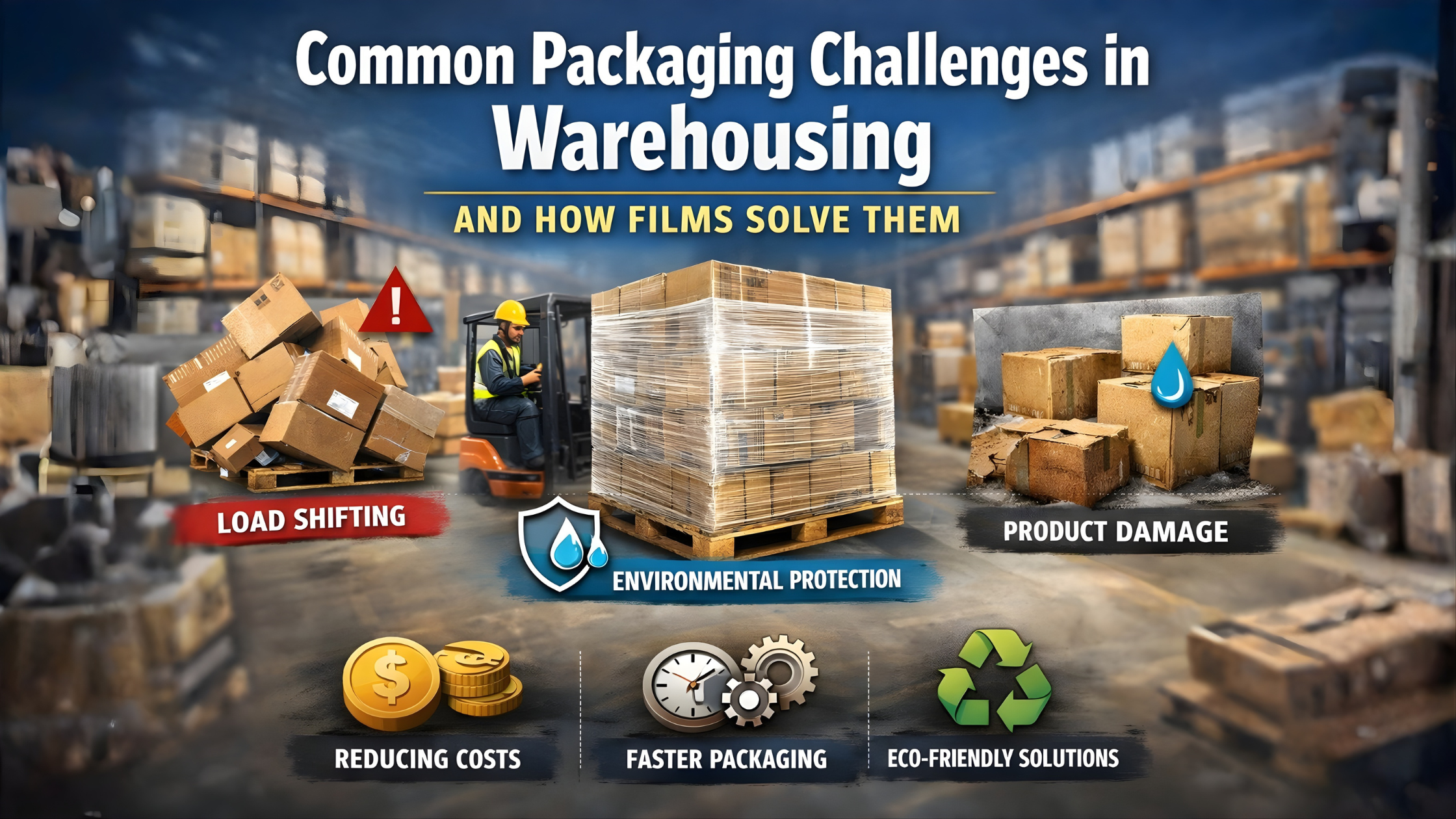
Warehouse operations face a constant battle against packaging inefficiencies, product damage, and rising operational costs. Every day, logistics managers grapple with loads that shift during transport, products that arrive damaged, and packaging materials that fail to deliver adequate protection. These challenges don’t just impact the bottom line they affect customer satisfaction, brand reputation, and overall supply chain efficiency.
Modern packaging films have emerged as powerful solutions to these persistent problems, offering versatility, protection, and cost-effectiveness that traditional packaging methods simply cannot match. Understanding these common challenges and how advanced film technologies address them is essential for any warehouse operation seeking to optimize performance and reduce losses.
Challenge 1: Load Shifting and Instability During Transit
One of the most prevalent issues in warehousing is load instability. When palletized products shift during transportation, the consequences ripple throughout the supply chain. Items become misaligned, creating unbalanced loads that are dangerous to handle. Products get damaged, leading to returns and customer complaints. In worst-case scenarios, unstable loads cause workplace accidents or complete pallet failures.
This problem intensifies with mixed pallets containing items of varying sizes, weights, and shapes. Traditional strapping methods often fail to provide uniform containment across the entire load, leaving gaps where movement can occur. The challenge becomes even more acute during long-distance transportation, where loads experience constant vibration, acceleration, and deceleration.
How Films Solve Load Stability Issues
High-quality wrapping polythene creates a unified containment system that holds loads securely in place. Unlike rigid strapping that only secures specific points, stretch films wrap the entire load surface, distributing containment force evenly across all products. This comprehensive coverage prevents individual items from shifting independently.
The elastic memory of polyethylene films provides continuous tension that adapts to load settling. As products naturally compress slightly during the first hours after wrapping, the film maintains its grip rather than becoming loose. This dynamic tension is crucial for maintaining security throughout extended shipping periods.
Modern stretch films also offer different cling levels and stretch ratios optimized for specific load types. For irregular loads, higher stretch percentages conform to contours and cavities, while controlled cling prevents film layers from separating. The result is a stable, secure load that arrives at its destination exactly as it left the warehouse.
Challenge 2: Product Damage from Environmental Factors
Warehouses and distribution centers expose products to numerous environmental threats. Dust and debris accumulate on open shelves and during handling. Moisture from humidity, condensation, or weather infiltration can damage packaging and compromise product integrity. Temperature fluctuations affect sensitive materials, while UV exposure degrades certain products during outdoor storage or open-transport.
The costs associated with environmental damage extend beyond the product itself. Damaged goods require inspection, repackaging, or disposal. Customer satisfaction suffers when products arrive dirty or moisture-damaged. Insurance claims and replacement shipping add administrative burden and expense. For food products and pharmaceuticals, environmental contamination can create safety concerns and regulatory issues.
How Films Provide Environmental Protection
Packaging films create an effective barrier between products and environmental hazards. The continuous wrap provided by stretch films seals out dust, dirt, and debris, maintaining product cleanliness throughout the storage and distribution process. This protection is particularly valuable for products stored in open warehouses or transported in uncovered vehicles.
Moisture resistance is another critical benefit. Quality polyethylene films are inherently water-resistant, protecting products from humidity, condensation, and minor water exposure. When properly applied with adequate overlap, films create a waterproof seal that prevents moisture infiltration. This protection is essential for paper goods, electronics, textiles, and any products susceptible to water damage.
For specialized applications, films with UV stabilizers protect products during outdoor storage or extended exposure to sunlight. These additives prevent the film itself from degrading while shielding products from harmful UV radiation. Similarly, films with specific permeability characteristics can be selected to manage moisture vapor transmission for products requiring breathability, such as fresh produce.
Challenge 3: High Packaging Material Costs
Budget constraints affect every warehouse operation, and packaging materials represent a significant ongoing expense. Traditional packaging methods often require multiple materials strapping, corner boards, cardboard sleeves, and protective wraps each adding to the cost. Labor expenses compound as workers spend time applying these various materials. Material waste from over-application or incorrect sizing further erodes profitability.
The challenge intensifies as shipping volumes increase. Operations that once found traditional packaging economical discover that costs become prohibitive at scale. Warehouses also face disposal costs for packaging waste, including both the initial packaging materials and any damaged products requiring repackaging. Rising material costs and sustainability pressures make packaging efficiency more critical than ever.
How Films Reduce Packaging Expenses
Stretch films offer exceptional cost-effectiveness by replacing multiple packaging materials with a single solution. One roll of quality stretch film can secure hundreds of pallets, eliminating the need for strapping, tape, corner boards, and additional protective materials in many applications. This consolidation reduces both material purchases and inventory management complexity.
The efficiency gains extend to labor costs. Applying stretch film whether manually or with automated equipment is significantly faster than traditional packaging methods. Workers can wrap pallets in minutes rather than the extended time required for strapping, banding, and securing with multiple materials. This speed translates directly to labor savings and increased throughput.
Material utilization efficiency further reduces costs. Modern stretch films, particularly pre-stretched varieties, deliver exceptional load coverage from each roll. The high stretch ratios mean less film weight is required per pallet while maintaining superior holding force. Working with experienced stretch film suppliers helps operations select optimal gauge and formulation for their specific needs, maximizing cost efficiency without compromising protection.
Challenge 4: Inconsistent Packaging Quality
Quality inconsistencies plague warehouses relying on manual packaging processes. Different workers apply materials with varying tension, overlap, and coverage. Some loads receive excessive packaging wasting materials while others get inadequate protection, risking damage. This variability makes it difficult to predict packaging costs accurately and creates uncertainty about load security.
Training challenges compound the problem. High employee turnover means constant retraining on proper packaging techniques. Even experienced workers may develop shortcuts or bad habits that compromise quality. Without consistent standards and processes, achieving reliable packaging outcomes becomes nearly impossible.
How Films Enable Consistent Results
Stretch films naturally promote more consistent packaging compared to rigid materials. The visual feedback provided by film tension helps workers gauge appropriate application, even without extensive training. The forgiving nature of stretch films means minor application errors rarely result in complete packaging failure, unlike strapping that can be incorrectly tensioned or positioned.
Pre-stretched films take consistency even further by eliminating the stretching variability inherent in manual application. Since the film arrives already stretched to optimal specifications, workers simply apply it without needing to gauge proper tension. This standardization ensures every pallet receives equivalent protection regardless of who performs the wrapping.
For operations requiring maximum consistency, machine-applied films eliminate human variability entirely. Automated wrapping equipment applies precise film patterns with controlled tension, overlap, and coverage. Programmable settings ensure identical wrapping for similar loads, while sensors adjust automatically for different pallet heights and configurations. This consistency translates to predictable costs, reliable protection, and reduced quality-related issues.
Challenge 5: Handling Diverse Product Types and Sizes
Modern warehouses rarely handle uniform products exclusively. Operations must accommodate everything from small boxes to large equipment, from rigid containers to flexible bags, from stable cubes to irregular shapes. Each product type presents unique packaging challenges. Rigid packaging materials designed for one application perform poorly with different load configurations, forcing warehouses to maintain extensive packaging material inventories.
Seasonal variations and customer diversity intensify this challenge. A warehouse might handle small consumer goods during one period and large industrial components the next. Custom orders require flexibility in packaging approaches. This diversity makes standardization difficult and increases the complexity of packaging material management.
How Films Accommodate Product Diversity
The inherent flexibility of packaging films makes them ideal for diverse product handling. Stretch films conform to virtually any load shape, from perfect cubes to irregular assemblies. The same roll of film that secures stacked boxes also protects machinery with protruding components or bundles of pipes and tubes. This versatility eliminates the need for specialized packaging materials for different product types.
Film width and thickness selection provides additional adaptability. Narrow films efficiently wrap small items and bundles, while wider films cover large pallets with fewer revolutions. Thin-gauge films suffice for light, uniform loads, while heavy-gauge options provide extra puncture resistance for products with sharp edges or corners. This scalability allows warehouses to optimize material selection for each application without maintaining vast packaging inventories.
Different film formulations address specific product requirements. Standard clear films allow visual inspection and barcode scanning. Opaque films provide security for valuable goods. Vented films accommodate products requiring airflow. VCI films protect metal components from corrosion. This range of specialized options means nearly any packaging challenge can be addressed with the appropriate film product.
Challenge 6: Time-Consuming Packaging Processes
In fast-paced warehouse environments, time is money. Packaging processes that slow down operations create bottlenecks, reduce throughput, and increase labor costs. Traditional packaging methods often require multiple steps: positioning corner boards, applying strapping, tensioning, sealing, and inspecting. Each step consumes time and requires worker attention and skill.
The problem intensifies during peak seasons when order volumes surge. Packaging stations become choke points, limiting the warehouse’s ability to handle increased volume. Overtime costs escalate, yet output remains constrained by packaging speed. Operations struggle to balance packaging quality with speed requirements, often sacrificing one for the other.
How Films Accelerate Packaging Operations
Stretch films dramatically reduce packaging time compared to traditional methods. Manual wrapping with hand-held dispensers allows workers to secure pallets in 2-3 minutes far faster than applying multiple straps and securing them. The continuous wrapping motion is ergonomic and intuitive, requiring minimal training to achieve proficiency. Workers can maintain high speed without compromising quality.
For high-volume operations, machine wrapping takes speed to another level. Automated wrapping equipment can secure pallets in under one minute with no manual effort beyond positioning the load on the turntable. Workers simply load the next pallet while the machine completes the previous wrap cycle. This automation eliminates packaging as a bottleneck, allowing throughput to be limited by other factors like picking speed or truck availability.
Pre-stretched films accelerate manual operations by reducing the physical effort required. Workers maintain faster wrapping speeds throughout their shifts because they’re not constantly stretching film. Reduced fatigue means sustained productivity and fewer errors, even during extended work periods. The combination of speed, ease, and consistency makes film-based packaging significantly more efficient than alternatives.
Challenge 7: Difficulty Meeting Sustainability Goals
Environmental responsibility has moved from optional to essential for modern warehouses. Customers demand sustainable practices, regulations require waste reduction, and corporate policies mandate environmental stewardship. Traditional packaging generates substantial waste: cardboard, plastic strapping, foam padding, and various protective materials that often aren’t recyclable or biodegradable.
Disposal costs compound environmental concerns. Warehouses pay for waste removal, and customers face their own disposal challenges when receiving packaged goods. The environmental impact of packaging materials from production through disposal increasingly factors into supplier selection and customer satisfaction. Operations lacking sustainable packaging solutions face competitive disadvantages and potential regulatory issues.
How Films Support Sustainability Initiatives
Modern packaging films offer multiple sustainability advantages. The material efficiency of stretch films means less plastic is used per pallet compared to other packaging methods. High stretch ratios and thin-gauge formulations deliver protection with minimal material weight. This efficiency reduces both raw material consumption and transportation costs for the packaging materials themselves.
Recyclability is another key advantage. Polyethylene stretch films are widely recyclable, and many facilities accept them in their recycling streams. Some film suppliers offer take-back programs for used films, ensuring proper recycling. Coreless film options eliminate cardboard core waste entirely, reducing disposal requirements and making the recycling process cleaner.
For operations requiring even greater sustainability, biodegradable films provide protection that breaks down over time. These advanced formulations maintain the performance characteristics necessary for effective load security while offering reduced environmental persistence. Recycled-content films incorporate post-consumer or post-industrial waste, creating circular economy opportunities within packaging operations.
Selecting the Right Film Solutions for Your Warehouse
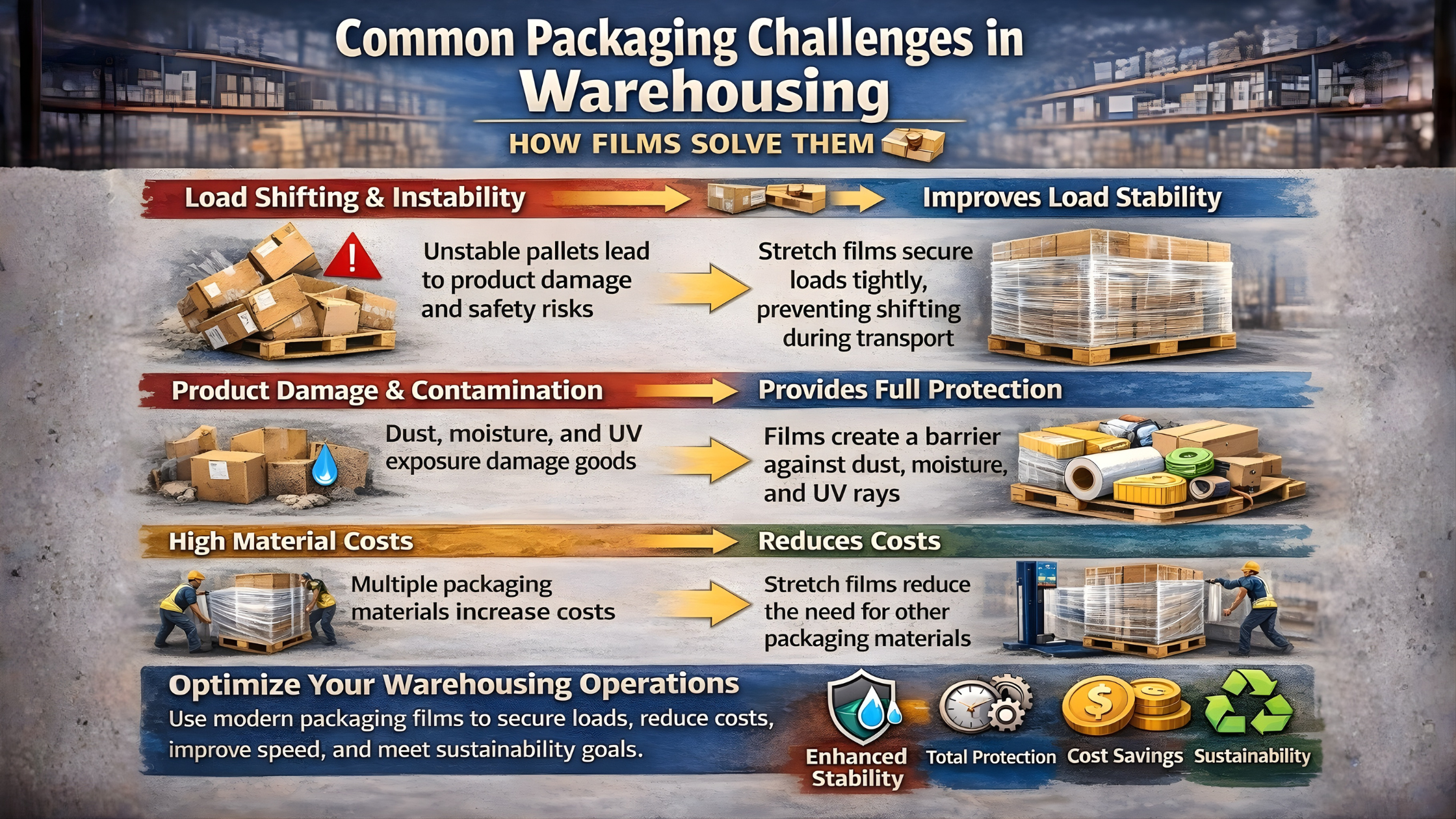
Successfully addressing packaging challenges requires matching film characteristics to specific operational needs. Film thickness, width, stretch ratio, and special properties should align with product types, storage conditions, and distribution requirements. Working with knowledgeable suppliers helps optimize these selections, ensuring maximum performance and cost-effectiveness.
Consider conducting packaging audits to identify your specific challenges and opportunities. Document current packaging costs, damage rates, processing times, and material waste. This baseline data helps evaluate improvement opportunities and measure results after implementing film solutions. Many suppliers offer technical support to help analyze your operations and recommend optimal products.
Training is essential for maximizing film performance. Even the best products deliver suboptimal results if incorrectly applied. Invest in proper technique training for manual wrapping operations, covering topics like appropriate tension, overlap percentage, number of wraps, and anchoring methods. For automated systems, ensure operators understand equipment settings and maintenance requirements.
The Competitive Advantage of Optimized Packaging
Warehouses that successfully address packaging challenges gain significant competitive advantages. Reduced damage rates improve customer satisfaction and reduce costly returns. Lower packaging costs flow directly to improved profitability. Faster packaging processes enable higher throughput without facility expansion. Consistent quality enhances brand reputation and customer loyalty.
These advantages compound over time. Operations with superior packaging capabilities can accept more diverse product types, expanding business opportunities. Reliability builds customer confidence, supporting premium pricing and preferred supplier status. Sustainability credentials attract environmentally conscious customers and satisfy corporate responsibility requirements.
At Tilak Polypack, we’ve spent over 20 years helping warehouses solve packaging challenges with innovative film solutions. Our extensive product range from standard stretch films to specialized formulations for unique applications ensures we can address virtually any packaging requirement. We serve customers globally across the US, Singapore, Australia, Germany, Canada, New Zealand, United Kingdom, Ireland, Scotland, and Norway, bringing world-class packaging expertise to operations of all sizes.
Conclusion: Transform Challenges into Opportunities
Every packaging challenge represents an opportunity for improvement. Load instability, environmental damage, high costs, quality inconsistencies, product diversity, time constraints, and sustainability pressures all have proven film-based solutions. The key is understanding your specific challenges and selecting appropriate products and processes to address them.
Modern packaging films offer unmatched versatility, protection, and efficiency for warehouse operations. Whether you’re struggling with specific packaging issues or seeking to optimize overall performance, film solutions provide clear paths to improvement. The investment in quality packaging materials and proper application techniques delivers returns through reduced damage, lower costs, faster processing, and improved customer satisfaction.
Partner with experienced suppliers who understand warehousing challenges and can recommend optimal solutions for your operations. Tilak Polypack combines manufacturing expertise with application knowledge to deliver packaging solutions that truly solve problems. Our customizable products, technical support, and commitment to quality ensure you have the tools needed to overcome packaging challenges and build a more efficient, profitable warehouse operation.