
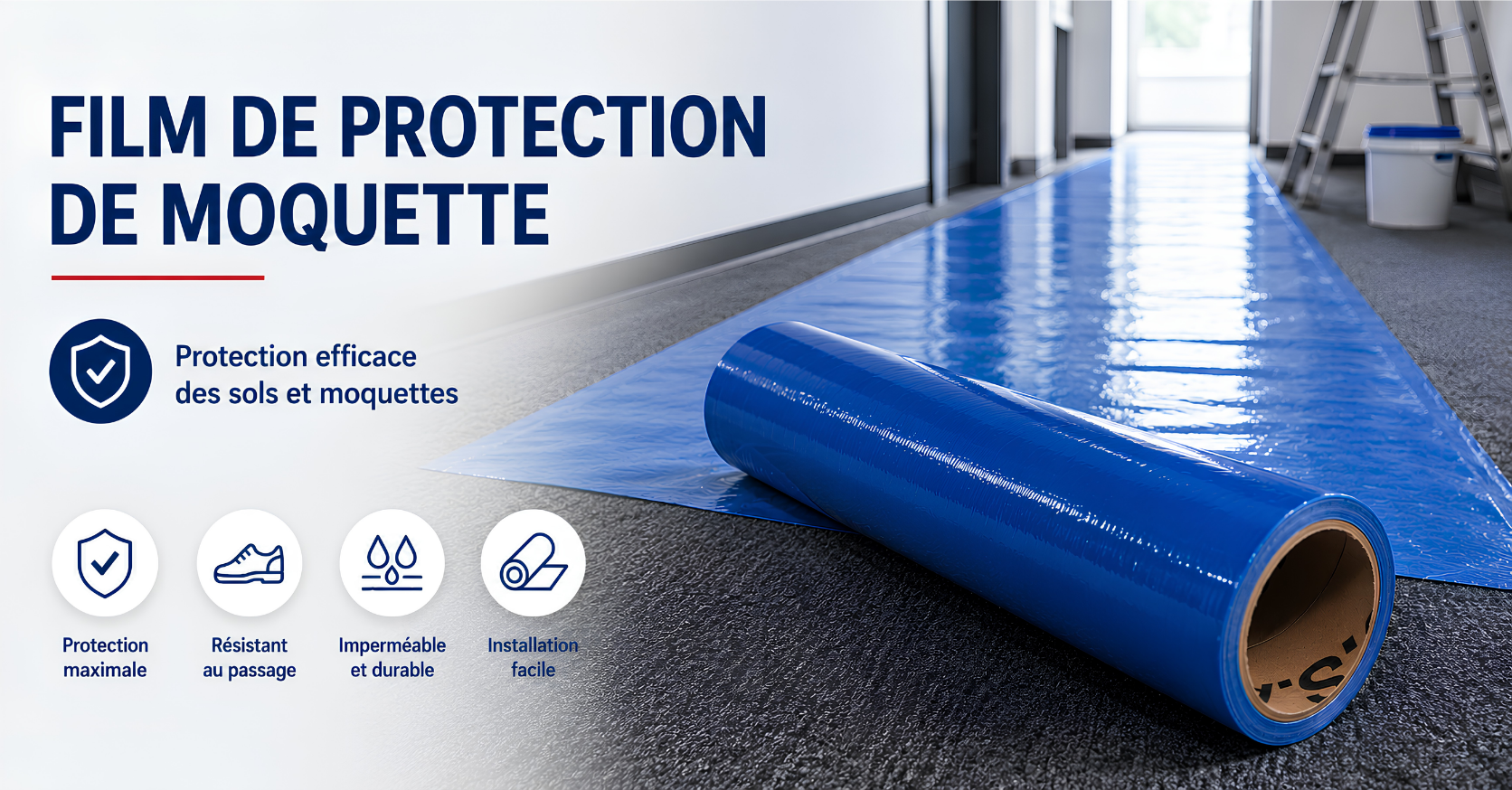
In the building, renovation, and maintenance sectors, maintaining cleanliness and surface safety is crucial. Floors, and carpets in particular, are often the first to be exposed to dirt, impacts, and premature wear during maintenance work. It is in this context that carpet protection film has become an essential solution.
Designed to meet the demands of modern construction sites, this protective film preserves textile coverings while facilitating movement, team operations, and finishing management. It is not merely a protective accessory, but a true tool for optimizing on-site operations, particularly valued in industrial and professional environments.
Carpet protection film: a technical solution for demanding environments
Carpet protection film is a temporary polyethylene coating designed to cover and protect textile surfaces. Its unique feature is its ability to adhere directly to the carpet thanks to a specially formulated adhesive system, without requiring any additional fixing.
Unlike traditional tarpaulins, which are often unstable and slippery, this adhesive floor film is applied directly to the surface and stays perfectly in place. It effectively protects against dust, dirt, paint splashes, and construction debris. This physical barrier also prevents abrasive particles from becoming embedded in the fibers, thus extending the lifespan of the flooring.
In industrial environments or busy construction sites, this solution makes it possible to maintain a constant level of cleanliness, even in the event of heavy pedestrian traffic.
Technical features designed for performance on the construction site
The effectiveness of a protective film depends primarily on the quality of its materials and design. The product developed by Tilak Polypack stands out due to its use of ultra-resistant polyethylene, capable of withstanding mechanical stresses and the demanding conditions of professional environments.
Its robust, stretchable structure allows it to resist tearing, even under constant pressure. This resistance is particularly important on construction sites where the repeated movement of workers, equipment, or tools can quickly damage standard protective gear.
One of its most innovative aspects lies in its installation system. The roll is designed with reverse winding, with the adhesive side facing outwards. This configuration greatly simplifies installation and allows for quick unwinding without any special effort.
Furthermore, the film offers controlled adhesion: it sticks effectively to the carpet without leaving any residue upon removal. This feature is essential to ensure clean worksite protection without damaging the original surface.
An essential solution for construction and renovation projects
In the construction industry, surfaces are constantly exposed to multiple risks: plaster dust, paint splashes, heavy foot traffic, humidity, and tool friction. Carpet protection film directly addresses these issues by creating a reliable barrier between the floor and construction site activity.
During construction work, it helps protect areas already completed, particularly in residential, commercial, or industrial spaces under development. Carpeted floors, often expensive and delicate, are thus preserved until the final project delivery.
In professional environments such as offices or hotels undergoing renovation, this type of protection is particularly useful for maintaining a clean and organized image of the worksite. It also helps reduce restoration costs at the end of the project by limiting defects and damage.
A major advantage during painting and decorating work
Painting and decorating are among the riskiest treatments for floor coverings. Splashes, accidental spills, and foot traffic can quickly alter the appearance of carpets.
The protective film acts as an essential barrier. Thanks to its resistant and waterproof surface, it prevents liquids and particles from penetrating the textile fibers. This protection is particularly valuable in interior renovation projects where deadlines are tight and spaces must remain usable between different stages of construction.
By minimizing damage, carpet protection film also significantly reduces the final cleaning workload. This allows teams to focus on finishing touches rather than floor restoration.
Safety and optimization of construction sites: an industrial challenge
Beyond simply protecting surfaces, the film plays a crucial role in overall site safety. Traditional solutions like tarpaulins or non-adhesive coverings can slip, wrinkle, or create tripping hazards.
The adhesive floor film solves this problem by remaining perfectly fixed to the surface. Its controlled adhesion guarantees optimal stability, even under heavy foot traffic. It also adheres to shoe soles, thus limiting the spread of dust and dirt in clean areas.
In industrial environments, this stability helps to facilitate movement and reduce the risk of accidents. It also improves the organization of workspaces by maintaining clearly protected and secure areas.
Quick installation and simplified use in the field
One of the main advantages of this type of solution lies in its ease of installation. On a construction site where time is a critical factor, speed of implementation is essential.
The film unrolls directly onto the carpet without the need for complex tools. Thanks to its integrated adhesive system, it automatically adheres to the surface as soon as it is unrolled. This simplicity allows teams to protect large areas in a very short time.
Once in place, the film remains stable and effective throughout the duration of the work. It can be easily removed at the end of the project, without leaving any traces or sticky residue, which is a major advantage compared to other, less effective protective solutions.
Cleaning, removal and reuse: an economical and clean solution
Removing carpet underlay is just as important as installing it. In professional environments, it’s essential that this process leaves no residue or damage to the protected surfaces.
Thanks to its high-quality design, the film peels off cleanly without damaging the carpet fibers. This feature helps maintain a high level of finish, even after intensive use.
Another significant advantage lies in the possibility of partial reuse. A roll that is not fully used can be saved for other projects, improving cost-effectiveness and reducing material waste.
A site protection solution adapted to international standards
In an increasingly demanding market, the quality of protective materials has become a determining factor. Tilak Polypack has established itself as a recognized player in the manufacture of industrial protection solutions, particularly in the field of carpet protective film .
Present in many international markets, the manufacturer meets the needs of building professionals in different countries, offering products adapted to the highest performance and safety standards.
This international dimension reflects the reliability of the product and its ability to adapt to a wide variety of construction sites, whether residential, commercial or industrial.
Conclusion: an indispensable tool for protecting professional floors
In construction, renovation, and maintenance environments, protecting textile surfaces is a strategic imperative. Carpet protection film has emerged as an effective, durable, and easy-to-use solution capable of meeting the most demanding requirements.
By combining strength, ease of installation, and safety, it optimizes site management while reducing restoration costs. Its role goes far beyond simple protection: it contributes to improving the overall quality of projects and strengthening the efficiency of teams in the field.