
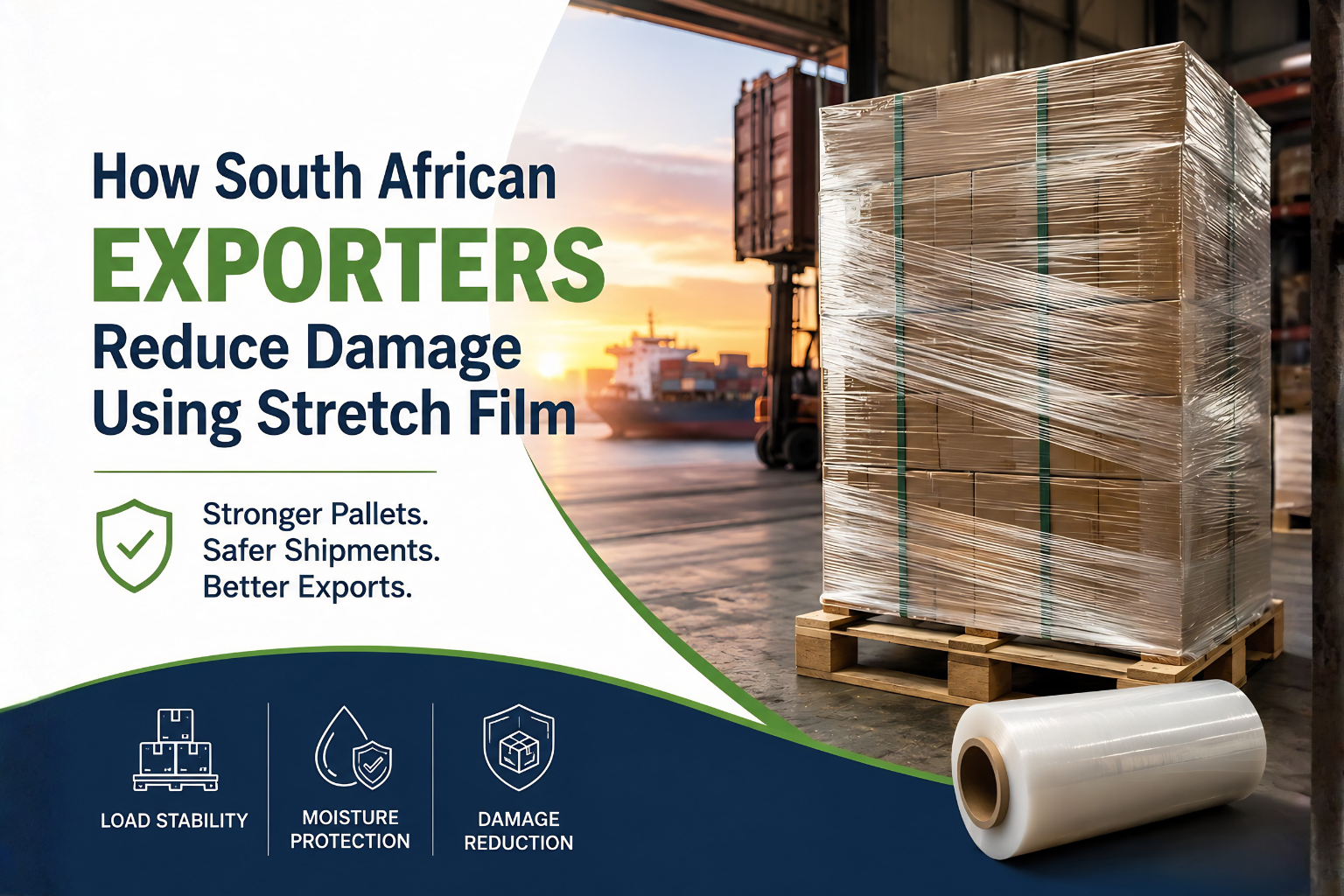
Export packaging failures are one of the most expensive operational issues facing logistics managers and exporters across South Africa. From pallet collapse during road transport to moisture exposure inside shipping containers, even minor packaging weaknesses can result in damaged goods, rejected shipments, insurance claims, and customer disputes. This is one reason why demand for high-performance stretch film South Africa solutions continues to grow across warehousing, agriculture, manufacturing, and export sectors.
For many exporters, packaging is no longer treated as a basic operational expense. It has become a critical part of supply chain risk management. Whether shipping fresh produce to Europe, industrial components across Southern Africa, or FMCG products through domestic distribution networks, proper pallet containment directly affects delivery quality and profitability.
Stretch film plays a central role in protecting palletized goods during handling, storage, and transportation. When applied correctly, it stabilizes loads, minimizes carton movement, protects products from contamination, and improves handling efficiency throughout the logistics chain.
Why Export Damage Is a Growing Concern in South Africa
South African exporters operate within a demanding logistics environment. Long-distance road transportation, multiple handling points, port congestion, fluctuating temperatures, and containerized shipping all increase the likelihood of pallet instability.
Agricultural exporters face additional complications. Fresh produce shipments often move through cold-chain systems where condensation buildup and temperature fluctuations can weaken packaging integrity. Industrial manufacturers, meanwhile, frequently transport heavy or irregular pallet loads that are vulnerable to shifting during transit.
In many cases, damage does not occur because of poor products. It happens because pallets were insufficiently stabilized before leaving the warehouse.
This is where high-quality export packaging film becomes essential. A properly engineered stretch film provides tension retention, elasticity, and puncture resistance that helps maintain load integrity throughout transportation.
How Stretch Film Improves Load Stability During Transport
Stretch film works by applying controlled containment force around palletized goods. The film stretches during application and attempts to return to its original shape, creating consistent pressure around the load.
This pressure helps prevent:
- Carton movement
- Pallet leaning
- Product toppling
- Vibration damage
- Dust contamination
- Moisture exposure
In South African export logistics, where pallets may travel hundreds or thousands of kilometers before reaching ports or distribution hubs, maintaining this stability is critical.
A common issue in export operations is load shifting caused by uneven roads and repeated forklift handling. Once cartons begin moving within a pallet stack, the risk of collapse increases significantly. High-performance pallet protection wrap reduces this movement by tightly unitizing the load.
For exporters shipping mixed cartons or irregular products, stretch film also improves stacking security without requiring excessive strapping or corrugated reinforcement.
The Role of Export Packaging Film in South African Supply Chains
The growing use of stretch film across South African industries reflects broader changes in supply chain operations. Warehouses are under pressure to improve throughput while reducing packaging waste and transportation losses.
Unlike traditional packaging methods, stretch film offers flexibility across different load sizes and product categories. It can be applied manually in smaller facilities or through automated wrapping systems in high-volume distribution environments.
In export-focused operations, packaging efficiency matters for another reason: container optimization. Stable pallet loads allow exporters to maximize container utilization while reducing the risk of internal cargo movement during sea freight.
For procurement teams, this creates measurable operational benefits:
- Lower product returns
- Reduced repacking costs
- Faster warehouse handling
- Improved pallet consistency
- Better inventory protection
These factors explain why stretch film South Africa searches increasingly come from logistics companies, agricultural exporters, warehouse operators, and industrial procurement managers rather than only packaging distributors.
Common Industries Using Stretch Film in South Africa
Agriculture and Fresh Produce
South Africa’s agricultural export sector depends heavily on secure pallet packaging. Citrus, grapes, avocados, and vegetables frequently move through refrigerated transport networks before export.
Vented stretch film is especially valuable in these applications because it allows airflow around palletized produce. Proper ventilation helps reduce condensation buildup while maintaining load containment.
Exporters also benefit from UV-resistant films when products are temporarily stored outdoors before shipment.
FMCG and Retail Distribution
Retail supply chains require fast pallet movement through warehouses and distribution centers. Stretch film helps maintain pallet integrity during repeated loading and unloading operations.
Transparent films also support barcode visibility and faster inventory inspections, which is important in high-volume FMCG environments.
Manufacturing and Industrial Goods
Industrial manufacturers often transport heavy or irregular-shaped products that place additional stress on packaging materials.
Machine-grade stretch film with higher puncture resistance is commonly used for:
- Automotive components
- Construction materials
- Industrial chemicals
- Engineering products
- Export machinery parts
These applications require films capable of maintaining containment force under heavy load conditions.
Cold Chain and Pharmaceutical Logistics
Temperature-sensitive goods require packaging materials that remain stable in refrigerated environments.
Low-quality film may lose elasticity under cold conditions, resulting in loose pallets and product instability. High-quality pallet protection wrap maintains tension consistency even in demanding cold-chain operations.
Choosing the Right Pallet Protection Wrap for Export Operations
Not all stretch films perform the same way. Buyers selecting packaging materials for export applications should evaluate more than just price per roll.
Film performance depends on several factors:
Film Thickness
Thicker films generally provide higher puncture resistance and load containment. However, over-specifying thickness can increase material consumption unnecessarily.
For many export operations, selecting the correct micron level depends on:
- Pallet weight
- Product shape
- Transportation distance
- Handling frequency
- Storage conditions
Stretch Capacity
High-stretch films improve material efficiency because they cover more pallet area with less film usage.
Pre-stretched films are particularly useful in facilities aiming to reduce operator fatigue and packaging waste.
Cling Performance
Proper cling characteristics help layers bond together securely without adhesives. Poor cling can result in loose wrapping and unstable loads.
Environmental Conditions
South African exporters operating in coastal or humid environments often require moisture-resistant and UV-stabilized packaging solutions.
For outdoor storage or extended transit durations, environmental resistance becomes especially important.
Hand Wrap vs Machine Wrap: Which Is Better for Exporters?
The choice between hand-grade and machine-grade stretch film usually depends on packaging volume and warehouse automation levels.
Hand wrapping remains common among small and medium exporters because it requires minimal equipment investment. It also provides flexibility for irregular pallet loads.
However, manual wrapping often creates inconsistent film tension, which can affect load stability during transportation.
Machine wrapping offers several operational advantages:
- Consistent containment force
- Faster pallet throughput
- Reduced film waste
- Improved wrapping uniformity
- Lower long-term labor costs
Large export warehouses and logistics hubs in South Africa increasingly adopt automated wrapping systems to improve packaging consistency and operational efficiency.
Important Technical Features Buyers Should Evaluate
Procurement managers should assess technical film specifications carefully before selecting a supplier.
Key considerations include:
- Puncture resistance
- Load retention strength
- Film memory
- Tear resistance
- UV protection
- Antistatic properties
- Core compatibility
- Machine compatibility
Reliable manufacturers also offer customized film widths, thicknesses, and additives based on operational requirements.
For export applications, consistency matters more than occasional low pricing. Variations in film quality can create major downstream logistics problems.
How Stretch Film Helps Reduce Packaging Costs
Many buyers initially view stretch film only as a consumable expense. In practice, it often reduces overall packaging and logistics costs when properly optimized.
Stable pallets reduce:
- Product breakage
- Repacking labor
- Freight damage claims
- Warehouse handling disruptions
- Packaging material waste
High-performance export packaging film may also reduce the need for excessive strapping or secondary corrugated reinforcement.
Over time, these operational savings often outweigh small differences in film purchase price.
Common Mistakes Exporters Make With Stretch Wrapping
Even high-quality stretch film can perform poorly when applied incorrectly.
Some common packaging mistakes include:
- Using incorrect film thickness
- Applying insufficient wrap tension
- Failing to secure pallet bases
- Overwrapping lightweight loads
- Ignoring load shape irregularities
- Using hand film on automated machines
Another frequent issue is selecting film based solely on cost rather than application suitability.
Experienced exporters usually work closely with packaging suppliers to optimize wrapping methods, film specifications, and containment performance.
Why South African Buyers Choose Reliable Stretch Film Manufacturers
Industrial buyers increasingly prioritize supply reliability, technical consistency, and customization capabilities when sourcing packaging materials.
A dependable stretch film manufacturer helps businesses maintain operational continuity while adapting packaging specifications to changing logistics demands.
Tilak Polypack supplies stretch film solutions designed for industrial, warehousing, and export applications across South Africa. The company offers customized film widths, thicknesses, UV-resistant options, and machine-compatible solutions tailored to different industries.
For exporters handling agricultural products, FMCG goods, industrial equipment, or palletized retail shipments, selecting the right packaging partner directly affects transportation efficiency and cargo protection.
Businesses looking for durable and cost-effective packaging solutions can explore customized stretch film South Africa options for export and warehouse applications.
Conclusion
Export packaging performance has become a critical operational factor for South African businesses competing in regional and international markets. Damaged pallets, unstable loads, and transit-related losses affect profitability far beyond the packaging department.
Stretch film helps solve these challenges by improving load containment, reducing product movement, and protecting goods throughout transportation and storage.
For exporters, warehouse operators, and procurement teams, selecting the correct pallet protection wrap is not simply about packaging material selection. It is part of building a more reliable, efficient, and damage-resistant supply chain.