
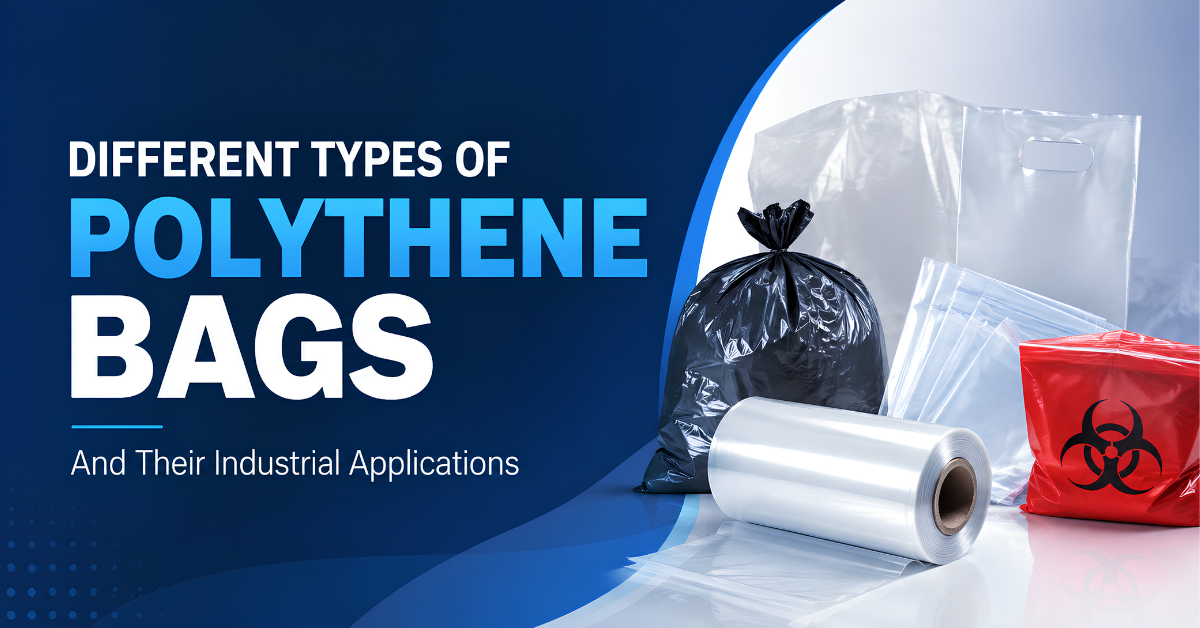
Polythene bags are widely used across industrial, commercial, retail, food, pharmaceutical, and manufacturing sectors because they provide a practical combination of flexibility, lightweight construction, moisture resistance, and product protection. However, polythene bags are not limited to one standard design. They are available in different materials, sizes, thicknesses, formats, and closure options to meet the requirements of specific applications. Choosing the right type depends on factors such as product weight, dimensions, handling conditions, visibility requirements, and the level of protection needed. Understanding the different types of polythene bags can help businesses select suitable packaging for their production, storage, and distribution processes.
What Are Polythene Bags?
Polythene bags are flexible packaging products manufactured from polyethylene film. Polyethylene is a widely used polymer because it can be processed into films with different levels of thickness, strength, flexibility, and transparency. These properties allow manufacturers to produce bags for lightweight retail products as well as demanding industrial applications.
Polythene bags can be produced in different dimensions and configurations depending on their intended use. They may be clear, colored, printed, open-ended, heat sealable, or designed with specialized closures. Their ability to protect products from dust and moisture while remaining lightweight makes them suitable for a wide range of packaging operations.
Clear Polythene Bags
Clear polythene bags are among the most commonly used types of polyethylene packaging. Their transparent construction allows the contents to remain visible, making them particularly useful when quick product identification is important.
These bags are commonly used for retail merchandise, garments, components, spare parts, documents, food-related products, and general industrial items. Warehouses and distribution businesses can also benefit from clear bags because workers can identify the contents without opening the packaging.
For retail applications, transparent packaging can also provide a clean and professional presentation while allowing customers to see the product inside.
LDPE Polythene Bags
LDPE polythene bags are manufactured using low-density polyethylene and are known for their flexibility, softness, and clarity. Their ability to stretch and conform around products makes them useful for applications involving lightweight or irregularly shaped items.
LDPE bags can be used across food packaging, retail, pharmaceutical, electronics, manufacturing, and general industrial applications. They are also suitable for applications where heat sealing is required.
Businesses that need flexible packaging with good transparency and moisture resistance often select LDPE bags because they offer a useful balance between ease of handling and product protection.
Heavy-Duty Polythene Bags
Heavy-duty polythene bags are designed for applications where standard lightweight bags may not provide sufficient strength. They are generally manufactured using thicker polyethylene film to provide greater resistance to tearing and puncturing.
These bags can be used for industrial components, machinery parts, bulk materials, construction-related products, and other heavier goods. The required thickness should depend on the product weight, shape, handling conditions, and transportation requirements.
For businesses moving products through multiple stages of storage and distribution, selecting an appropriate heavy-duty bag can help reduce packaging failures caused by excessive loading or rough handling.
Polythene Clothing Bags
Clothing and garment packaging requires protection from dust, moisture, and handling while maintaining a clean appearance. Polythene clothing bags are designed for packaging garments and textile products during manufacturing, storage, transportation, and retail distribution.
Clear versions are particularly useful because they allow the garment to remain visible while protecting it from external contaminants. Clothing manufacturers, wholesalers, retailers, dry cleaners, and distributors can use these bags to organize and protect finished garments.
The bag dimensions can also be selected according to the size and type of clothing being packaged, from individual garments to larger textile products.
Mailing Polythene Bags
Mailing polythene bags are designed for shipping products through courier, postal, and distribution networks. They are lightweight while providing protection against moisture, dust, and routine handling during transportation.
These bags are commonly used by e-commerce businesses, retailers, distributors, and manufacturers shipping lightweight products directly to customers or commercial buyers. Depending on the design, mailing bags can incorporate self-sealing closures to make packaging faster and more convenient.
Their lightweight construction can also help businesses simplify fulfillment operations while maintaining basic protection for the packaged product.
Retail Display Polythene Bags
Retail display bags are designed with product presentation in mind. Clear polyethylene film allows customers to view the contents while keeping the product enclosed and protected.
These bags can be used for accessories, small consumer products, garments, hardware items, stationery, and other merchandise. Their transparent appearance makes product identification easier and can reduce the need for additional packaging materials.
For retailers, the right display packaging can combine product protection with a simple and organized presentation.
Printed Polythene Bags
Printed polythene bags allow businesses to incorporate branding, product information, handling instructions, or other graphics directly onto the packaging. This makes the bag both a protective packaging material and a communication medium.
Printed bags are used across retail, manufacturing, food-related businesses, promotional packaging, and distribution. Companies can use customized printing to create a consistent packaging appearance and improve product identification throughout their supply chain.
The printing requirements depend on the intended application, design, quantity, and surface characteristics of the polyethylene film.
Biohazard and Specialized Waste Bags
Certain industrial, medical, laboratory, and healthcare environments require specialized bags for the controlled handling of potentially contaminated materials. Biohazard bags are designed for applications where clear identification and appropriate containment are important.
These bags may be manufactured in specific colors and configurations to support established waste-handling procedures. They can be used in healthcare facilities, laboratories, research environments, and other settings where specialized waste segregation is required.
Businesses should always select specialized waste bags according to the applicable handling procedures and regulatory requirements for their industry.
Polythene Liners
Polythene liners are used inside containers, cartons, drums, boxes, and other larger packaging structures. Instead of functioning as an external shipping bag, the liner creates an internal protective layer around the product.
Industrial liners can help protect contents from moisture, dust, dirt, and contact with the container itself. They are commonly used for powders, granules, raw materials, agricultural products, chemicals, and various manufactured goods, depending on the required material specifications.
The appropriate liner thickness and dimensions depend on the product characteristics and the container in which the liner will be installed.
How Industries Use Different Polythene Bags
Different industries select polythene bags according to their individual packaging requirements. Manufacturing companies may use heavy-duty bags for components and finished products, while retailers often prefer clear bags for product visibility. Textile businesses can use clothing bags to protect garments during storage and transportation.
Food-related operations may require suitable polyethylene packaging for handling and protecting products, while pharmaceutical and healthcare environments may prioritize cleanliness, consistency, and controlled packaging conditions. Distribution and e-commerce companies can use mailing bags for lightweight shipments.
This wide range of applications demonstrates why polythene bags are considered versatile packaging solutions across multiple sectors.
Factors to Consider When Selecting Polythene Bags
Businesses should evaluate several factors before selecting a particular type of polythene bag. Product weight is important because heavier products generally require stronger or thicker film. Product dimensions determine the appropriate bag size, while shape can influence the level of flexibility required.
Transparency should also be considered when product visibility is important. Businesses may choose clear bags for retail and identification purposes or opaque options when visibility needs to be limited. Closure requirements, storage conditions, transportation methods, and expected handling should also be evaluated.
Selecting the correct combination of material, thickness, dimensions, and design can improve packaging performance and reduce unnecessary material usage.
Choosing a Reliable Polythene Bag Manufacturer
Consistent manufacturing quality is important when polythene bags are used in commercial and industrial operations. Variations in film thickness, dimensions, sealing quality, or material performance can affect packaging efficiency and product protection.
Businesses should therefore work with manufacturers capable of producing bags according to defined specifications and application requirements. An experienced supplier can help customers identify suitable polyethylene materials, dimensions, thicknesses, and bag formats for their intended use.
For companies sourcing polythene bags in Kenya, selecting a dependable manufacturer can provide access to packaging solutions designed for different industrial, retail, food, pharmaceutical, and distribution requirements.
Conclusion
Polythene bags are available in many different forms, allowing businesses to select packaging according to their products and operational requirements. Clear bags provide product visibility, LDPE bags offer flexibility and clarity, heavy-duty bags provide additional strength, clothing bags protect textiles, mailing bags support shipping operations, and specialized formats serve industrial and healthcare applications.
The right choice depends on the product, weight, dimensions, handling environment, protection requirements, and intended use. By understanding the differences between various types of polythene bags, businesses can select packaging that supports efficient handling, storage, transportation, and product presentation. Working with an experienced manufacturer can further help businesses identify suitable specifications for their specific packaging needs.