
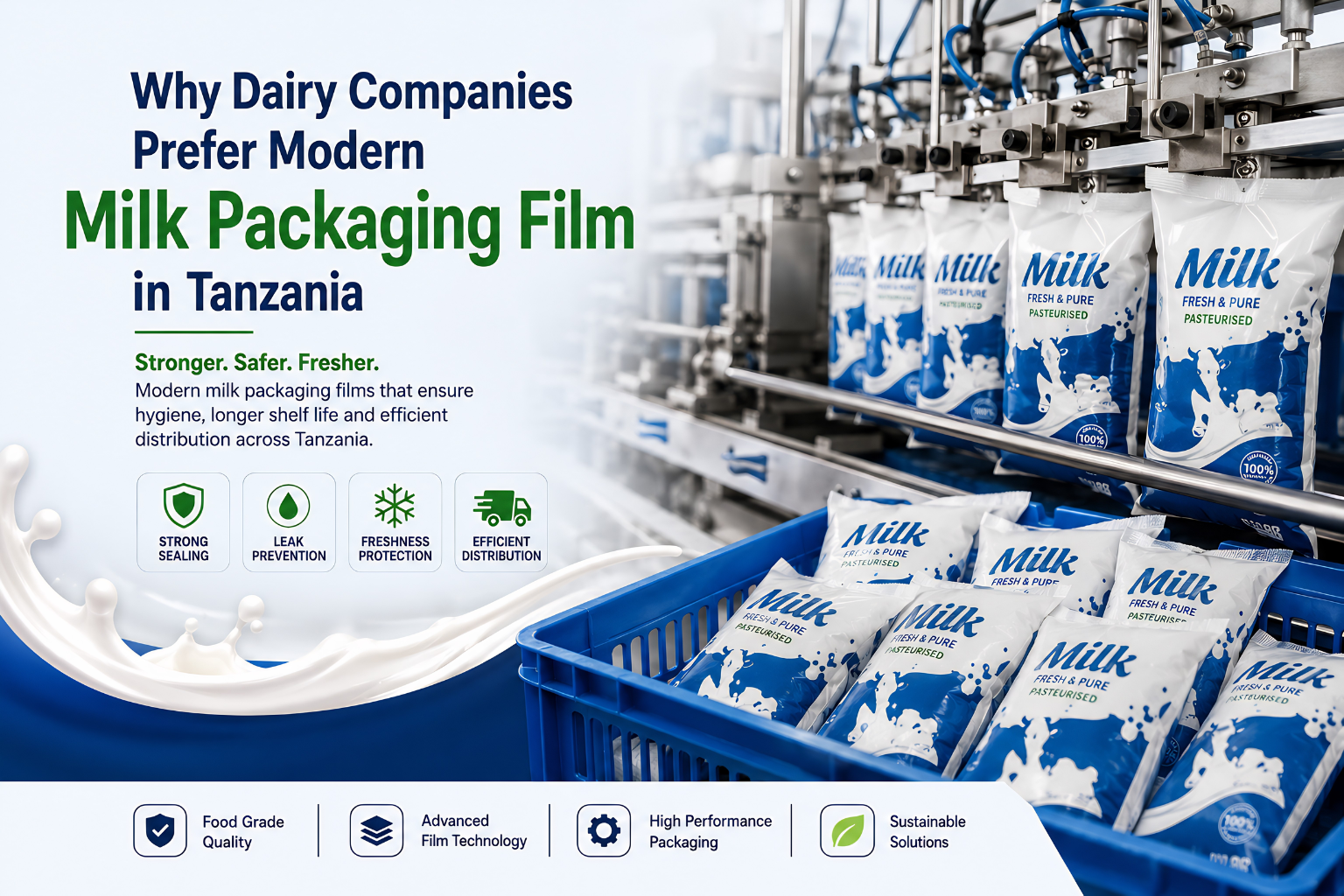
Tanzania’s dairy sector has been expanding steadily as urban consumption rises and regional distribution networks become more organized. Alongside increased milk production, packaging standards have also evolved. Today, many processors are investing in better pouch packaging systems to improve hygiene, transportation efficiency, and shelf stability. This growing demand is one of the key reasons why milk packaging film Tanzania searches have increased among dairy processors, distributors, and packaging procurement teams.
Milk is one of the most sensitive liquid food products in the packaging industry. Unlike bottled water or edible oil, milk is highly vulnerable to bacterial contamination, temperature fluctuations, leakage, and handling damage during transportation. For dairy companies operating across Tanzania, especially those distributing to both urban supermarkets and regional retail channels, packaging reliability has become a critical operational requirement rather than just a branding decision.
Modern milk pouch packaging helps dairies maintain product quality while supporting faster filling operations, lower logistics costs, and safer retail distribution.
Growth of Tanzania’s Dairy Packaging Sector
The Tanzanian dairy industry has seen increasing investment in processing infrastructure over the past several years. More dairy businesses are moving from loose milk distribution toward packaged milk products because consumers now expect safer and more hygienic packaging.
This shift is particularly visible in cities such as Dar es Salaam, Arusha, Mwanza, and Dodoma, where retail chains and convenience stores demand professionally packed dairy products with clear labeling and reliable sealing.
As processors scale operations, packaging requirements become more technical. A small dairy producer may initially focus only on filling efficiency, but larger operations must consider:
- Seal integrity during transportation
- Shelf-life stability
- Branding visibility
- Leakage reduction
- Cold storage handling
- Material consistency for automated filling lines
This is where modern dairy pouch film solutions become essential for operational consistency.
Why Milk Requires Specialized Packaging Film
Milk packaging cannot rely on ordinary flexible film structures. The packaging material must provide food-grade protection while maintaining flexibility and sealing strength under varying transportation and refrigeration conditions.
Milk naturally contains proteins, fats, and moisture that create an environment where bacterial growth can develop quickly if packaging integrity fails. Even small seal weaknesses may result in contamination or leakage during distribution.
Modern milk pouch films are engineered specifically for these challenges. Manufacturers use carefully selected polymer structures such as LDPE, LLDPE, and sometimes HDPE for UHT applications to balance flexibility, durability, and sealing performance.
For dairy processors in Tanzania, the packaging film must also perform well under practical field conditions. Distribution routes may involve long transportation times, mixed storage conditions, and repeated handling before the product reaches retailers.
A properly manufactured milk pouch film helps processors reduce product loss while maintaining consumer confidence.
Challenges Faced by Dairy Processors in Tanzania
One of the biggest operational concerns for dairy companies in Tanzania is maintaining product quality across different distribution environments. Cold-chain infrastructure continues to improve, but consistency still varies between urban and regional markets.
This creates several packaging-related risks:
Leakage During Transportation
Milk pouches are often stacked in crates, transported over long distances, and exposed to repeated handling. Weak seal areas or inconsistent film thickness can lead to punctures and leakage.
Modern milk packaging films are designed with stronger seal performance and flexible durability to withstand transport stress.
Hygiene and Contamination Control
Food safety has become increasingly important for both regulators and consumers. Packaging film must act as a hygienic barrier that prevents external contamination throughout storage and distribution.
Food-grade raw materials and controlled manufacturing environments help ensure compliance with dairy packaging standards.
Efficient High-Speed Filling
Many dairy companies are upgrading from semi-automatic systems to high-speed pouch filling lines. Packaging films must therefore maintain dimensional consistency and reliable sealing behavior during continuous production runs.
Inconsistent film quality can slow production and increase wastage rates.
How Modern Milk Packaging Film Improves Distribution Efficiency
Flexible milk pouch packaging provides several logistical advantages for dairy businesses operating across Tanzania.
Compared to rigid bottles, pouch packaging reduces storage requirements significantly. Empty pouches occupy far less warehouse space, allowing processors to optimize inventory handling and reduce transportation costs.
This becomes especially important for businesses supplying high-volume daily milk consumption markets.
Modern pouch films also improve pallet efficiency. More units can be transported within the same shipment volume, helping distributors reduce freight costs across regional routes.
Additionally, milk pouches are easier to handle during loading and unloading operations. Their lightweight structure supports faster retail replenishment while reducing packaging waste generation compared to rigid alternatives.
For dairy businesses managing competitive pricing pressures, these operational efficiencies directly influence profitability.
Importance of Seal Strength and Leak Prevention
In dairy packaging, seal performance often determines whether a product reaches the consumer safely.
Weak sealing can result in:
- Product contamination
- Retail rejection
- Transportation losses
- Brand reputation damage
- Increased operational waste
Modern milk packaging films are engineered to maintain strong heat-sealing characteristics even during high-speed filling operations. Advanced sealing layers improve bonding consistency while maintaining flexibility.
Leak prevention is particularly important in Tanzania’s regional distribution environment, where products may experience extended transit times and variable storage temperatures.
Reliable seal strength also helps processors maintain freshness during refrigerated storage.
Film Materials Used in Dairy Pouch Packaging
Different milk products require different film structures depending on shelf-life targets and operational requirements.
LDPE and LLDPE Films
Most standard milk pouch applications use LDPE or LLDPE because these materials provide:
- Excellent flexibility
- Good sealability
- Strong puncture resistance
- Efficient processing behavior
These materials are commonly used for pasteurized milk distributed within shorter supply cycles.
HDPE for UHT Applications
For longer shelf-life products such as UHT milk, HDPE structures may be incorporated to improve barrier performance and structural strength.
The choice of film depends on:
- Distribution distance
- Filling technology
- Shelf-life requirements
- Storage conditions
- Transportation exposure
Experienced packaging suppliers usually help dairy processors determine the appropriate structure based on operational needs rather than using generic film specifications.
Printing and Branding Advantages for Tanzanian Dairy Brands
Packaging today is not only functional. It also plays a major role in product visibility and consumer trust.
Modern rotogravure and flexographic printing technologies allow dairy companies to print high-quality branding directly onto the pouch surface.
This helps processors include:
- Brand logos
- Nutritional information
- Batch details
- Manufacturing dates
- Regulatory markings
- Retail branding elements
For growing dairy brands in Tanzania, professionally printed milk pouches improve shelf recognition and support market expansion.
High-quality printing also helps distinguish premium dairy products from unbranded or low-quality alternatives commonly found in informal markets.
Why Flexible Milk Pouch Packaging Is Preferred Over Bottles
Many dairy businesses in Tanzania are gradually shifting toward flexible packaging because of operational efficiency.
Rigid bottles offer structural advantages but introduce higher logistics costs, greater storage requirements, and increased transportation weight.
Flexible milk pouch packaging offers practical commercial benefits including:
- Lower packaging material consumption
- Reduced freight costs
- Improved warehouse efficiency
- Faster handling operations
- Easier disposal for consumers
For high-volume daily milk distribution, these benefits become highly significant.
Pouch packaging also supports scalable production growth because dairies can increase filling output without proportionally increasing packaging storage infrastructure.
Food Safety and Regulatory Considerations
Food-contact compliance is extremely important in dairy packaging.
Milk packaging films should be manufactured using food-grade materials that comply with international safety standards. Many exporters and large dairy processors now prefer suppliers that follow FDA and EU food-contact guidelines.
This is especially important for businesses targeting supermarket distribution or export-oriented operations.
Procurement teams should evaluate suppliers based on:
- Food-grade certification
- Material traceability
- Quality control systems
- Consistency of film thickness
- Printing ink safety
- Sealing performance testing
Reliable documentation and production consistency reduce operational risk for dairy companies.
Sustainability Trends in Milk Pouch Packaging
Environmental considerations are becoming more relevant across African packaging industries, including Tanzania.
Modern milk pouch films are increasingly being designed with optimized material structures that reduce plastic consumption while maintaining performance standards.
Many manufacturers now produce recyclable monolayer film structures to support easier recycling processes.
Although recycling infrastructure continues to develop across many regions, material reduction strategies already help dairy companies lower packaging waste generation and transportation emissions.
Sustainable packaging decisions are also becoming more important for retail partnerships and international supply chains.
Choosing the Right Milk Packaging Film Supplier
Selecting the right packaging supplier involves more than comparing prices.
Dairy processors should evaluate suppliers based on technical capability, manufacturing consistency, export reliability, and packaging expertise.
A reliable supplier should provide:
- Consistent film quality
- Custom sizing options
- Technical packaging support
- Strong sealing performance
- Printing capabilities
- Bulk production capacity
- Food-grade compliance documentation
For Tanzanian dairy businesses expanding distribution networks, supply reliability becomes especially important because packaging interruptions can directly affect production schedules and retail commitments.
Working with an experienced manufacturer also helps processors optimize film structure according to filling machine compatibility and transportation conditions.
Conclusion
The growing demand for hygienic, efficient, and cost-effective dairy packaging is driving the adoption of modern milk pouch solutions across Tanzania.
As dairy distribution networks expand, packaging performance now plays a direct role in product safety, transportation efficiency, retail presentation, and operational profitability. Modern milk packaging film Tanzania solutions help processors reduce leakage risks, improve filling efficiency, maintain freshness, and support scalable distribution operations.
For dairy companies seeking long-term operational reliability, selecting the right milk packaging film supplier is no longer just a procurement decision. It is a critical part of maintaining product quality and supporting sustainable business growth in Tanzania’s evolving dairy sector.